
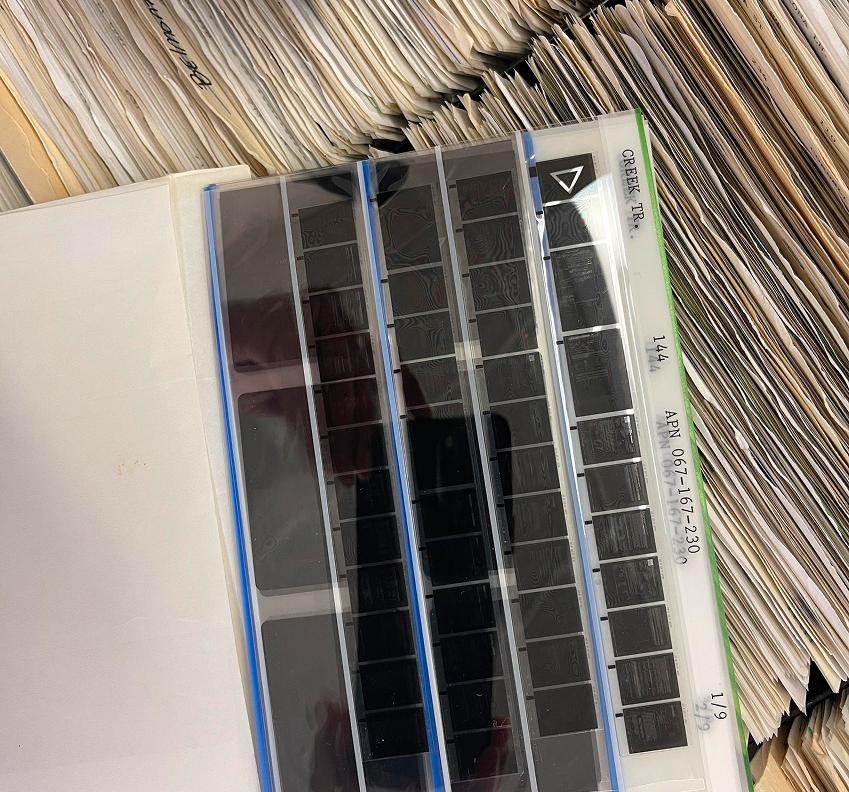
Microfilm Microfiche Scanning
Over 100 Five-star Reviews • 20+ Years of Experience • Serving the San Francisco Bay Area, California
Microfilm rolls and microfiche cards deteriorate on a predictable timeline. Acetate-based film develops vinegar syndrome. Older emulsions produce redox blemishes and silver mirroring. In Bay Area storage environments, coastal humidity and inland heat accelerate both processes. Once the emulsion layer breaks down or image detail is lost, recovery becomes impossible.
eRecordsUSA provides preservation-grade microfilm and microfiche scanning for institutions, government agencies, healthcare organizations, legal teams, engineering firms, and corporate archives across San Francisco, Oakland, San Jose, and the broader San Francisco Bay Area region.
All work is completed in-house at our secure Fremont, CA facility by a Bay Area-based team. Your records are never outsourced or shipped outside the region.
With more than 20 years of local digitization experience, ISO 9001:2015 and ISO 27001:2013 certification, and a controlled chain-of-custody workflow from intake to final digital delivery, eRecordsUSA is the trusted partner for bulk and institutional microfilm scanning projects throughout the Greater Bay Area.







Microfiche Scanning & Digitization
Professional microfilm and microfiche scanning creates high-resolution digital copies that can be searched, backed up, indexed, and shared without repeatedly handling the original media. This protects the physical archive while giving your team faster access to the records they need.


eRecordsUSA – Trusted Choice for Large Format Digitization
Preserve Fragile Originals
Professional high-resolution conversion captures durable digital replicas of aging cellulose acetate film before autocatalytic degradation (the vinegar smell) causes shrinkage, warping, and loss of image integrity.
Fully Searchable Archives
Scanned pages can be converted into searchable text using OCR, so users instantly locate articles, dates, headlines, or names without handling fragile film.
Reduce Physical Storage Footprint
Digitizing hundreds or thousands of microfilm rolls and microfiche sheets frees building space previously used for cabinets and reader rooms, lowering storage overhead and climate-control costs.
Protect Against Loss & Access Risk
Digital deliverables (TIFF, PDF, PDF/A, JPEG) allow secure backups, cloud or DMS import, and remote access, eliminating dependence on aging readers, trained operators, and single-location climate control that create continuity risk.
Our Secure 7-Step Scanning Workflow
How Does Our Microfilm & Microfiche Digitization Process Work?
Every microfilm and microfiche project at eRecordsUSA follows a documented, secure workflow managed by a dedicated project coordinator. From the first inquiry through final file delivery, your archive is tracked, handled, and returned with full accountability.
1. Free Consultation & Project Assessment

2. Secure Pickup or Drop-Off

3. Intake, Logging & Chain-of-Custody Assignment

4. Pre-Scan Inspection & Film Assessment
5. Preservation-Grade Scanning
7. Quality Review & Secure Digital Delivery
6. Indexing, OCR & File Structuring
Digitize Your Microfilm, Microfiche, and Aperture Cards
Who Can Benefit from Professional Microfilm & Microfiche Scanning?
Microfilm and microfiche collections often hold records that cannot be easily replaced. They may include patient files, court records, land documents, engineering drawings, newspapers, research archives, corporate records, or historical collections. eRecordsUSA serves almost every organization type to fulfil their microfilm and microfiche scanning requirements.

Audience Segments We Serve
- Enterprise & Technology — Facility Plans, Engineering Diagrams & Archive Blueprints - Apple Inc., AT&T, BioMed Realty, Vantage Data Centers, Matson Navigation, Tesco Metering
- Engineering, Construction & Utilities — Schematics, Site Layouts & Technical Drawings - Tyco (TE) Connectivity, Southland Industries, Sandis Engineers, SALAS O'BRIEN, Bagg Engineers
- Government & Public Sector — Infrastructure Records, Permits & Oversized Documentation - City of Santa Clara, County of San Mateo, State of California – Department of Industrial Relations
- Libraries, Cemeteries & Historical Archives — Oversized Posters, Plot Records & Archival Files - Redwood City Library, California State Library, Alameda Public Library, Castro Valley Public Library, The Company of Military Historians, Southern Pacific Railroad History Center, Cypress Lawn Cemeteries, St. Mary Cemetery
Microfilm & Microfiche Scanners
Which Microfilm & Microfiche Formats Does eRecordsUSA Digitize?
Microfilm and microfiche archives are rarely stored in a single format. Most institutional collections include a combination of roll film, flat fiche sheets, jacket fiche, aperture cards, and older specialty formats — sometimes mixed across decades of filing activity. eRecordsUSA scans the full range of archival microformats using professional-grade equipment and format-specific handling protocols.


Local Expertise. Certified Standards. Accountable Workflows
Why Choose eRecordsUSA for Microfilm & Microfiche Scanning?
At eRecordsUSA, microfilm and microfiche scanning is not just a conversion service; it is a specialized archival process designed for fragile, compliance-sensitive, and historically valuable records. Our systems, protocols, and expert team are purpose-built to handle legacy film formats with precision, consistency, and institutional-grade quality.
Purpose-Built for Complex Archival Media
Older microfilm and microfiche collections often require more than standard production scanning.
- Collections affected by vinegar syndrome, redox blemishes, water damage, or mixed film formats require pre-scan assessment.
- Format-specific handling helps protect fragile archival media during processing.
- Careful density calibration is performed before a single frame is captured.
- Technicians evaluate film base type, emulsion condition, and reduction ratio before assigning the correct scanning protocol.
- This approach helps protect image quality and reduce production errors that cannot be corrected after the fact.


Compliance-Driven, Certified Workflows
Microfilm and microfiche collections frequently contain records governed by legal, medical, educational, financial, or government compliance requirements.
- eRecordsUSA operates under ISO 9001:2015 quality management certification.
- eRecordsUSA also operates under ISO 27001:2013 information security certification.
- Production workflows are aligned to HIPAA, FERPA, PCI-DSS, and NARA digitization guidance.
- Scanning practices reference ANSI/AIIM recommended standards and FADGI image quality guidelines.
- SBA 8(a), WOSB, MBE, and Alameda SLEB certifications support public agency and institutional procurement.
In-House Bay Area Processing. No Outsourcing
All microfilm and microfiche scanning is completed at our secure Fremont, CA facility.
- Your records do not leave the Bay Area region.
- Secure local pickup is available across San Francisco, Oakland, San Jose, and surrounding cities and counties.
- Coverage includes the East Bay, South Bay, Peninsula, and North Bay.
- Free on-site parking and wheelchair-accessible entry are available.
- Multilingual project coordination is available in English, Hindi, Punjabi, Spanish, and Mandarin.


Enterprise and Government Scale
eRecordsUSA manages bulk microfilm scanning projects for libraries, universities, hospitals, government agencies, law firms, and corporate archives
- A dedicated project coordinator manages the collection from intake to final delivery.
- Milestone-based scheduling is available for large collections and compliance-deadline projects.
- Chain-of-custody accountability is maintained throughout the project.
- Personalized project coordination is provided instead of a one-size-fits-all approach.
- Institutions with ongoing digitization programs are supported through structured long-term engagement.

Microfiche and Microfilm Document Scanning FAQs
Can damaged microfilm still be scanned?
In many cases, yes. Microfilm with light vinegar syndrome, redox blemishes, fading, curling, or minor physical wear may still be scanned with careful handling. Severely damaged film may need review first to confirm whether scanning is safe.
Do you offer scanning for government agencies and public records?
Yes. eRecordsUSA supports government agencies, courts, public archives, and institutional record departments with secure microfilm and microfiche scanning. Projects can include land records, permits, court filings, vital records, COM fiche, and long-term public archive collections.
Can scanned microfilm be made searchable?
Yes. When the original images are clear enough, OCR can be applied to create searchable PDF or PDF/A files. This makes it easier to search names, dates, case numbers, document titles, and printed text inside the scanned records.
What file formats can we receive after scanning?
You can receive scanned files in formats such as TIFF, JPEG, PDF, or PDF/A. TIFF is often preferred for archival preservation, while PDF or searchable PDF is useful for daily access, sharing, and document retrieval.
What DPI is best for microfilm and microfiche scanning?
Most standard microfilm projects are scanned around 400 DPI, while fine-print records, engineering drawings, legal files, or detailed images may require 600 DPI. The right resolution depends on the source material, reduction ratio, and intended use.
How should we prepare bulk microfilm or microfiche before pickup?
Group the records by department, date range, document type, subject, or reel number. If possible, include a simple spreadsheet or note that explains the order, labels, and indexing preferences. This helps preserve your filing structure in the final digital archive.
What happens to the original microfilm after scanning?
Your original microfilm, microfiche, or aperture cards are organized and returned after the project is complete or shredded upon written request
How long does a bulk microfilm scanning project take?
Standard bulk microfilm projects are typically completed within 2–4 weeks, depending on collection volume, format condition, and indexing complexity. Rush timelines and milestone-based delivery schedules are available for institutional, government, or compliance-deadline projects. Turnaround is confirmed in writing at the project estimate stage.
Certified scanning, purpose-built for wide-format records
20+ Years of Trusted Microfilm & Microfiche Scanning Experience in the SF Bay Area
Since our founding, eRecordsUSA has provided microfilm and microfiche scanning services to libraries, government agencies, hospitals, universities, law firms, and corporate archives across San Francisco, Oakland, San Jose, and the full San Francisco Bay Area region.
Our Fremont, CA facility and Bay Area–based team have managed collections ranging from single-reel family archive projects to multi-institutional bulk digitization programs covering hundreds of thousands of frames.
As a women-owned, minority-owned, and certified small business with ISO 9001:2015 and ISO 27001:2013 accreditation, eRecordsUSA is positioned to serve both the institutional complexity of large public-sector and healthcare archives and the preservation urgency of estates, historical societies, and private collections.
Our 5-star ratings on Google and Yelp reflect a consistent record of project accountability, image quality, and client communication across more than two decades of Bay Area service. References are available upon request. Free consultations and no-obligation bulk estimates are available for all organizations — whether you are planning an immediate digitization project or conducting a long-range preservation assessment.
Top Scanning & Conversion Services
⭐ What Our Clients Are Saying: Real Results, Real Reliability
Rated 5 Starts For Our Document and Book Scanning Services
At eRecordsUSA, clients across libraries, museums, archives, academic institutions, and government agencies trust us with their most fragile and valuable collections. We don’t just scan—we preserve history. From non-contact scanning to metadata-rich indexing, we deliver digital archives that are as accurate as they are accessible.








Want to See How We Compare? Let us quote your next digitization project and show you why we’re trusted by leading institutions nationwide.