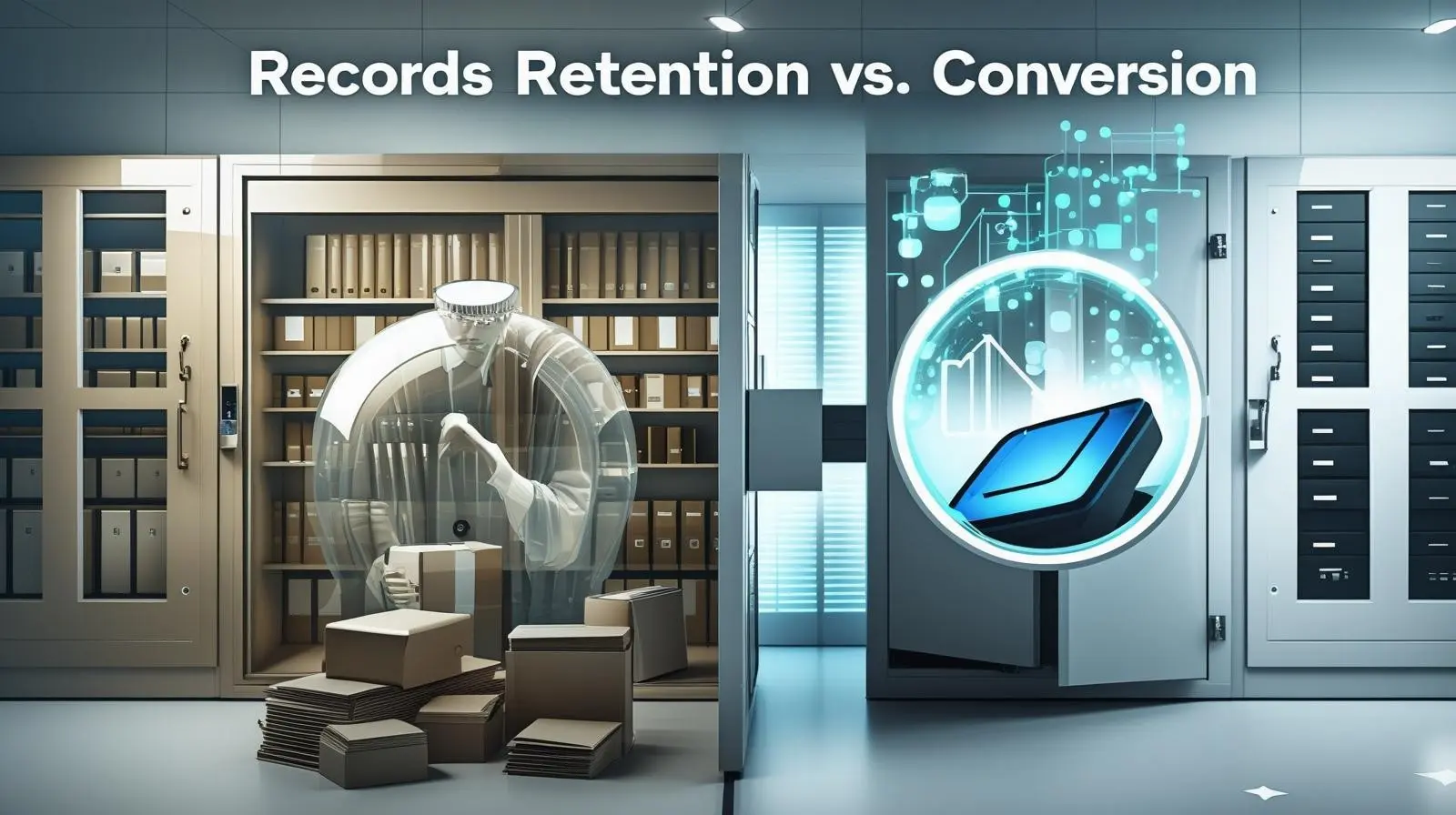
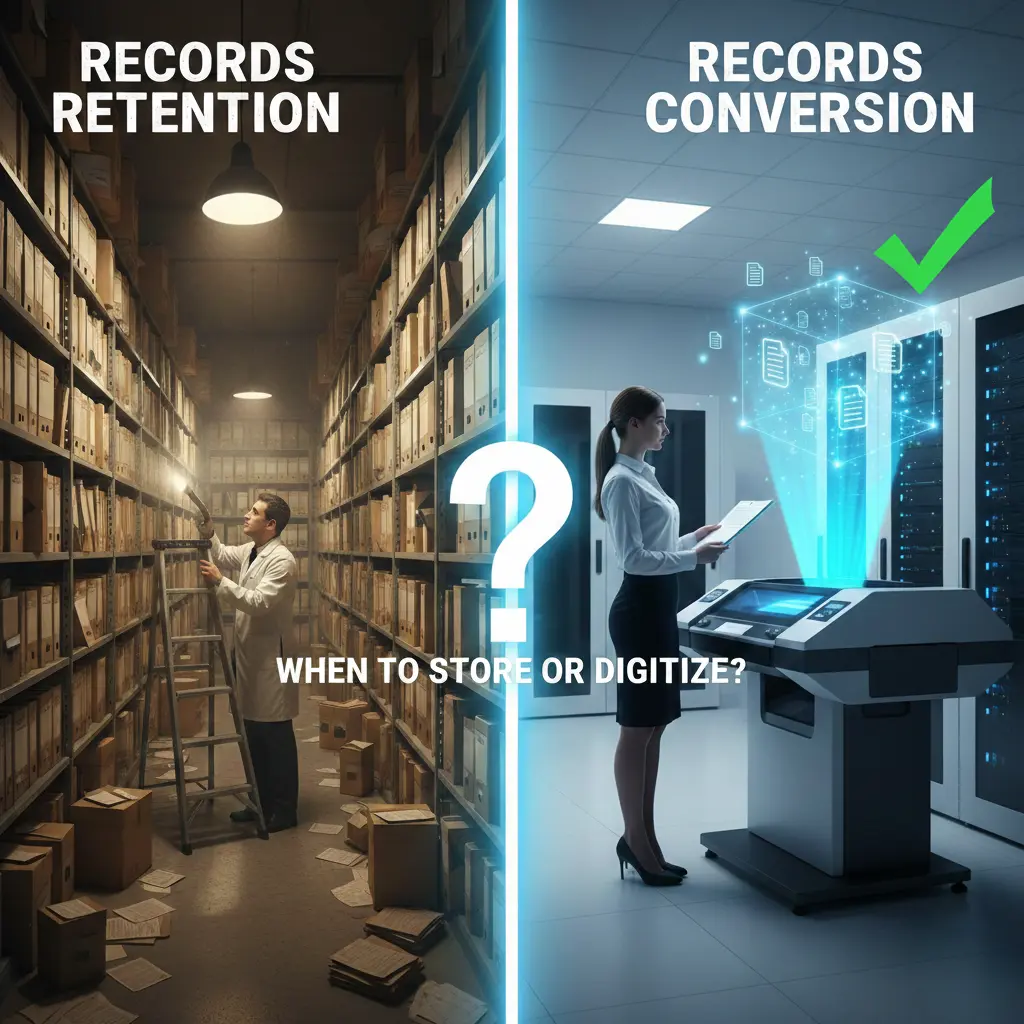
Are records retention and records conversion really solving the same problem in your organization, or are they designed for completely different stages of the records lifecycle? The two services are often discussed together under “records management,” but one focuses on preserving original files, while the other focuses on turning those files into usable digital information.
Records retention providers (such as traditional offsite storage companies) concentrate on secure physical records storage, compliance-based retention schedules, documented chain of custody, and controlled access to original paper documents. This approach supports organizations that must keep physical records intact for legal, regulatory, or operational reasons, even if those files are accessed only during audits or periodic reviews.
By contrast, records conversion specialists like eRecordsUSA address a different requirement: converting paper-based records into structured digital formats through document scanning, OCR, indexing, and secure electronic archiving. This model supports teams that need frequent access to historical information, faster retrieval, and tight alignment with document management platforms, case management tools, or other digital business systems instead of manual file handling.
This distinction is becoming more important as information volumes grow. Global data creation is expected to surpass 181 zettabytes, with a large share of enterprise content remaining unstructured across paper, legacy applications, and hybrid environments. At the same time, industry groups such as AIIM note that paper records and mixed-format repositories are still common for legacy, regulated, and archival content—forcing organizations to decide not just how long records are kept, but in what form those records should exist to support both compliance and digital operations.
Understanding how physical records retention and digital records conversion support different points in the records lifecycle is the first step to aligning your records strategy with how information is accessed, governed, and used across your organization.
Why Aren’t Records Retention and Records Conversion the Same Thing?
Think of records retention and records conversion as two different jobs in the same department—not one thing with two names. Both protect information, but they focus on different questions and different stages of the records lifecycle.
What question does each one answer?
- Records retention asks:
- “How long do we keep the original record, and how do we prove it was stored correctly?”
- “How long do we keep the original record, and how do we prove it was stored correctly?”
- Records conversion asks:
- “How do we turn this record into a usable digital file without losing integrity or compliance?”
What does records retention actually do?
- Keeps original paper files in secure, controlled storage.
- Follows a formal retention schedule (e.g., 7 years, 10 years, permanent).
- Tracks boxes and files with inventory and chain-of-custody logs.
- Supports audits, legal reviews, and regulatory checks using the physical record.
What does records conversion actually do?
- Scans paper or microfilm into digital formats (PDF, TIFF, PDF/A, etc.).
- Uses OCR and indexing so records can be searched by name, date, account, or case ID.
- Stores digital records in document management or case management systems.
- Keeps the information usable for daily work, reporting, and analytics—while retention rules still apply.
How do they work together?
- Retention protects the original record for as long as required.
- Conversion protects the information by moving it into a digital format that people can actually use.
- A retention partner may manage your boxes; a conversion specialist like eRecordsUSA prepares those same records for consistent digital access.
What Do Records Retention Companies Actually Do (and When Does That Model Fit)?
Records retention companies are the specialists you use when you must keep original records, but you don’t need to use them every day.
What is the main job of a retention provider?
- Store physical records (boxes, files, cartons) in secure offsite facilities.
- Apply retention schedules so each box/file is kept for the correct number of years.
- Maintain chain of custody and location tracking for every carton or file.
- Retrieve and return specific files when audits, legal reviews, or investigations occur.
These services are a fit when regulations or policies require original paper to be preserved, or when your records are rarely accessed but must be available on demand.
When does a retention-only model make sense?
Use a records retention provider when:
- Access is infrequent and mostly tied to audits, disputes, or compliance checks.
- Laws or internal policy say “keep the original paper for X years.”
- Your priority is risk management and traceability, not day‑to‑day digital use.
- You are in a transition period (merger, system migration, regulatory review) and need stable control over physical archives while you plan next steps.
Retention companies solve the “keep it safe and compliant” problem for physical records; conversion partners like eRecordsUSA solve the “make it digital and usable” problem once your teams need faster access and system integration.
What Do Records Conversion Specialists Do (and How Does That Enable Digital Transformation)?
Records conversion specialists step in when keeping boxes in storage is no longer enough and your teams need information to move at the same speed as your digital systems. Instead of focusing on where records sit, conversion focuses on how those records flow into everyday work, reporting, and decision-making.
What is the real job of a conversion provider?
Rather than re-storing records, a conversion partner redesigns how information shows up in your digital environment:
- Turns paper or microfilm into electronic files your systems can actually use (PDF, PDF/A, TIFF, etc.).
- Structures data with indexing and metadata so staff can find what they need by client, case, account, or date—not by box number.
- Aligns outputs with your existing tools (DMS, ECM, case management, ERP) so records land in the right place, with the right fields, ready to work.
- Applies quality checks to keep digital copies consistent and reliable across large, multi-year backfile projects.
eRecordsUSA specializes in this “make it work digitally” layer—large-scale scanning, OCR, and metadata preparation that turn static archives into usable, governed digital collections.
When does records conversion become the smarter move?
Conversion becomes the better long-term decision when the bottleneck is access and workflow, not storage space:
- Teams are repeatedly pulling the same records for audits, customer support, or casework.
- Staff in multiple offices—or remote staff—need the same information without waiting for boxes to ship.
- New applications, automations, or analytics projects depend on historical data that is still locked in paper.
- Leadership wants a consistent way to search, report, and govern records without juggling physical files.
In these scenarios, records conversion does not replace your retention rules—it brings those rules into a digital context where information can support daily operations, not just sit on a shelf
Record Retention vs. Record Conversion — A Side-by-Side Reality Check
| Aspect | Records Retention | Records Conversion |
|---|---|---|
| Primary focus | Maintaining physical records in a secure, compliant state | Preparing information for access and use in digital systems |
| What is preserved | Original paper documents | Information and its digital representation |
| Custody emphasis | Physical location, inventory tracking, and controlled handling | Documented handling during scanning, processing, and digital storage |
| Access method | Retrieval of physical files when requested | Search-based access using metadata and indexing |
| Typical use pattern | Infrequent access tied to audits or reviews | Regular access tied to operations and analysis |
| Operational role | Supports compliance and risk management | Supports compliance, workflows, reporting, and decision-making |
| Scalability model | Scales with storage volume | Scales with users, systems, and access needs |
| End state | Records remain stored until retention requirements expire | Records exist as searchable, governed digital assets |
Once the functional differences between retention and conversion are clear, the next consideration is timing. Organizations often reach a point where meeting compliance requirements is no longer the primary challenge; instead, the focus shifts to how records support ongoing work, audits, and growth.
When Is Records Conversion the Smarter Long-Term Decision?
Records conversion becomes the smarter move when your records stop being “just in case” assets and start becoming everyday inputs to how your teams work.
What are the signs it is time to convert?
You are likely at that point when:
- Staff regularly pull the same historical files for audits, customer queries, or case reviews.
- Different departments need to see the same information without waiting for boxes or file pulls.
- New digital workflows, automations, or analytics projects are blocked because key data is still trapped on paper.
How does conversion support long-term planning?
Over the long term, conversion shifts records from “stored” to “searchable”:
- Digital archives let you search, filter, and review records without touching physical files.
- Records can be governed consistently as volumes grow and access needs become more complex.
- Retention rules still apply, but they are now applied to digital objects that actually fit how your organization works today—and how it will operate across locations and systems in the future.
Why Does eRecordsUSA Focus on Records Conversion Instead of Storage?
eRecordsUSA steps in once organizations decide their records should fuel daily work, not just sit in boxes for compliance. The specialization is clear: rather than running long-term storage programs, eRecordsUSA focuses on turning legacy paper into reliable, structured digital information that fits modern systems and workflows.
What exactly does eRecordsUSA do?
Instead of managing warehouse shelves, eRecordsUSA concentrates on end-to-end records conversion projects:
- Preparing documents for high-volume scanning (sorting, organizing, exception handling).
- Applying quality controls so digital images and OCR output are consistent and trustworthy.
- Structuring metadata and index fields so records can be found by client, case, policy, matter, or date.
- Delivering digital archives that align with each client’s access, security, and governance requirements.
The emphasis is on accuracy, continuity, and system readiness—ensuring converted records can flow into document management, case management, or other line-of-business platforms without disrupting existing retention programs.
How should you choose the right partner for your records strategy?
The right partner depends on what you need your records to do next, not only how long you must keep them.
- If your primary need is regulated physical preservation, a records retention provider manages custody, retention schedules, and secure storage of original files.
- When the priority shifts to access, review, cross-location use, and system alignment, a conversion specialist such as eRecordsUSA prepares those same records for consistent digital use.
Successful records strategies match expertise to intent: preserving originals satisfies regulatory obligations, while converting records prepares information for ongoing use, automation, and growth. For teams ready to move beyond purely physical handling and into dependable digital access, working with a conversion-focused partner makes that transition deliberate and controlled—starting with a focused records conversion assessment and a plan that fits how your organization works today and where it is headed
FAQs About Records Retention vs Records Conversion
Can we convert records without disrupting our retention program?
- Yes. Records conversion runs alongside your existing retention schedule, not against it. Physical records can stay under retention control while selected files are scanned, indexed, and stored digitally, so you gain online access without changing how long records must be kept.
How do we decide which records to convert first?
- Most organizations start with records that create the most friction if they stay on paper. High-priority candidates include files used for audits, customer service, case work, or reporting, while very low-access boxes usually remain in physical retention until their retention period ends.
Does digitizing records change our legal or regulatory retention requirements?
- No. Digitization does not shorten, reset, or remove retention obligations. Retention policies still govern how long each record series must exist; conversion simply changes the format of those records so they can be accessed through digital systems instead of only as paper.
What should we ask a conversion partner before starting a project?
- Before you start, ask how the provider will:
- Map your record series and retention categories into digital structures (indexes, folders, metadata).
- Handle exceptions like mixed files, sensitive content, or legal holds.
- Integrate outputs with your document management or case management systems.
Clear answers to these questions make it easier to align conversion work with your governance and IT landscape.
What types of organizations see the biggest ROI from records conversion?
- Organizations that touch records constantly—not occasionally—see the most benefit. This often includes healthcare, legal, financial services, government, and multi-location enterprises where teams must share information quickly and support audits, customers, and operations with the same set of records.