How safe is a fragile book when it is placed on a high‑speed scanner built for office documents?
The honest answer is: not very safe. Delicate bindings, brittle paper fibers, and aging inks found in rare books and historical manuscripts react poorly to mechanical flattening, rapid page handling, and intense lighting cycles used by many commercial scanning devices.
Conservation bodies such as the Northeast Document Conservation Center (NEDCC) and the Library of Congress caution that forcing vulnerable volumes fully open or subjecting them to repetitive mechanical pressure can accelerate structural breakdown and long‑term damage.
One landmark assessment of large U.S. research libraries estimated that about 25% of their collections—roughly 76 million books—were already so brittle they would crumble if handled. (see “The Big Problem of Brittle Books”)
Preservation studies have found that over half of items in some library and archive collections show mechanical wear and tear, including damage from handling, photocopying, and flattening on scanners.
As acidic paper continues to age, experts warn that the percentage of brittle, at‑risk volumes will keep rising, making careful handling and digitization essential to long‑term preservation.
When cultural heritage materials are processed like everyday office files, the physical record is exposed to avoidable risks. A museum‑grade, non‑destructive book scanning workflow—using proper cradles, trained handling specialists, and preservation‑aligned imaging protocols—is designed to keep the original artifact stable while producing accurate digital reproductions. This is the foundation of how eRecordsUSA approaches fragile book scanning, as outlined in our own non‑destructive book scanning guide, ensuring that irreplaceable volumes retain their structural integrity throughout the digitization process.
Understanding the difference between a standard print‑shop method and a conservation‑driven approach is essential if you want to protect rare or sensitive items instead of unintentionally harming them. The sections below explain why most print‑shop workflows are risky for fragile books and what a museum‑grade process does differently.
Why Fragile Books Demand Special Treatment (and Why Most Print Shops Fall Short)
Fragile books require specialized scanning methods because their bindings, paper, and inks cannot withstand the pressure and motion of typical office scanners. Archival volumes often feature sewn or hand‑stitched bindings, embossed spines, brittle or acidic paper, and uncoated surfaces that were never designed to be forced flat to 180 degrees. Guidance from organizations like the NEDCC and the Canadian Conservation Institute emphasizes that inappropriate handling and flattening are major causes of binding damage in aging collections.
Most print shops and general document scanning services rely on equipment engineered for speed and modern paper, not for conservation. These systems frequently use automatic document feeders (ADFs), glass platens, and roller mechanisms that work well for loose office sheets but can tear, crease, or chip fragile pages when used on rare books. Unlike everyday publications, archival volumes may also contain marginal annotations, foldouts, maps, or parchment‑based pages that resist full opening; forcing them flat increases stress on the spine and inner margins and may cause irreversible harm.
Professional conservation protocols instead recommend cradle‑based support systems that allow books to remain partially open at a natural angle, reducing strain on bindings and hinges while still capturing a complete, legible image. Resources such as Yale Library’s guidance on care and handling of collections for digitization explain why supported, non‑destructive scanning is essential for rare materials. For example, imagine a 19th‑century ledger with a cracked leather spine and delicate stitched binding. Placing it on a standard flatbed scanner forces the covers backward, stressing the hinge and risking detachment of entire sections, whereas a V‑shaped cradle supports the book without flattening and preserves the original structure.
How Museum‑Grade Fragile Book Scanning Works (and What Happens Without It)
Museum‑grade scanning is a non‑destructive method designed to digitize fragile books without compromising their physical structure. Instead of treating rare volumes like office paperwork, this approach prioritizes the condition of the item, using specialized equipment, cradles, and trained technicians to minimize stress on bindings, paper, and inks. Non‑destructive book scanning is now widely recognized in the heritage sector as the preferred option for rare, valuable, or irreplaceable materials.
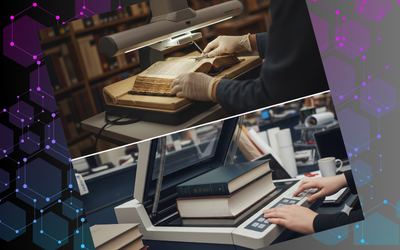
In a museum‑grade workflow, fragile books are typically placed in V‑shaped or adjustable cradles, allowing them to remain partially open at a comfortable angle while overhead or non‑contact book scanners capture each page. Lighting is usually provided by cool LED sources that avoid harmful UV and IR radiation, as used in modern heritage scanners such as the Bookeye series or ElarScan systems, which are purpose‑built for cultural heritage digitization. Trained operators turn each page by hand or with air‑assisted tools, avoiding the rollers, clamps, and auto‑feed mechanisms common in production office scanners.
These extra steps matter because fragile books often have degraded cellulose, loose stitching, and light‑sensitive inks that do not tolerate mechanical flattening or intense, repeated light exposure. A preservation‑driven process keeps contact and movement to the minimum necessary while still capturing high‑resolution images and detailed metadata for long‑term access. By contrast, using general office scanners or high‑speed devices on fragile items can introduce preventable risks that conservation guidance explicitly warns against
What Happens Without Specialized Fragile Book Scanners?
When fragile books are scanned on high‑speed or office‑grade devices, several types of damage can occur over time. Conservation and digitization case studies highlight recurring issues when historic volumes are forced flat or fed through automated scanners. Risks include:
- Cracked spines and weakened hinges from forcing books open beyond their natural opening angle.
- Torn pages, chipped edges, or detached sections caused by rollers, clamps, or repeated flattening under glass.
- Ink loss, smudging, or surface abrasion where printing or handwriting comes into contact with hard scanner components.
- Missing or distorted content in the gutter, marginalia, or near the binding that standard flat scanning fails to capture accurately.
- Loss of archival authenticity when incomplete or distorted scans are accepted as the “record copy” of a fragile original.
Organizations such as the Northeast Document Conservation Center (NEDCC), the Library of Congress, and IFLA emphasize that improper scanning can accelerate deterioration, not just capture it. Choosing a museum‑grade, non‑destructive approach is therefore not just about better images—it is about preventing avoidable damage to collections that may never be replaceable.
Why eRecordsUSA Is Trusted for Archival‑Grade Fragile Book Scanning?
eRecordsUSA applies a preservation‑first, non‑destructive workflow for fragile book scanning that aligns with best practices used by libraries, archives, and museums. Every project begins with a condition assessment, where technicians evaluate binding type, paper condition, and sensitivity to handling and light before choosing the appropriate scanning method. This mirrors recommendations from conservation bodies that stress assessment and planning as the first step in any digitization project involving vulnerable materials.
Based on this assessment, fragile books are scanned using overhead or non‑contact systems combined with V‑shaped or cradle supports, so no volume is forced flat or pushed through rollers. Our team uses manual, page‑by‑page handling rather than automatic feeders, and supports each item at a natural opening angle to protect the spine and joints. In our Bay Area facility, environmental considerations—such as controlled handling areas, anti‑static work surfaces, and clean, stable conditions—further reduce incidental wear during the scanning process.
For clients comparing options, our dedicated Fragile Book Scanning Services page explains how this approach differs from general document scanning and why it is recommended for rare or irreplaceable volumes. eRecordsUSA also captures pages at archival‑appropriate resolutions and delivers results in preservation‑friendly formats such as TIFF masters with PDF or JPEG access copies, along with structured metadata and indexing when required. This approach is consistent with the way memory institutions build digital surrogates that are suitable for long‑term access and future reuse, as described in guidelines from the Library of Congress and other heritage organizations. Projects are documented with handling notes, image quality checks, and secure transfer procedures so institutions, private libraries, and collectors can trace exactly how their fragile books were digitized.
Conclusion – Why Museum‑Grade Fragile Book Scanning Protects Your Collection
Entrusting fragile books to generic office scanners or high‑speed print‑shop equipment can create permanent damage that no digital copy can undo. Conservation guidance from organizations such as the Northeast Document Conservation Center, IFLA, and the Library of Congress consistently warns that forced opening, mechanical flattening, and inappropriate equipment accelerate deterioration in vulnerable volumes. Treating rare books like ordinary office files may seem cost‑effective in the short term, but it introduces avoidable risks for bindings, paper fibers, and inks that were never designed for this kind of stress.
A museum‑grade, non‑destructive scanning process—using supported cradles, overhead scanners, and trained handling specialists—keeps physical stress to a minimum while producing high‑quality digital surrogates. This is exactly the approach used in eRecordsUSA’s Fragile Book Scanning Services and our broader archival scanning solutions, helping libraries, archives, private collectors, and institutions digitize rare materials without compromising their long‑term survival. When preservation matters, choosing a specialist over a generic print shop is not just a preference—it is a responsibility to the collections you manage.
If you are considering a fragile book scanning project, you can review our tips on non‑destructive book scanning or contact eRecordsUSA for a preservation‑first consultation tailored to your collection.
FAQ About Fragile Book Scanning Services
1. Can fragile books be scanned without removing the binding?
- Yes. Non‑destructive, museum‑grade book scanning uses V‑shaped cradles and overhead scanners so books remain bound and partially open, avoiding the need for cutting spines or disbinding. This method follows the same general principles recommended by conservation organizations for handling rare and historical volumes.
2. What DPI resolution is ideal for scanning rare or antique books?
- For most rare or text‑heavy fragile books, 400–600 DPI is commonly recommended to capture fine detail, small type, and marginalia while keeping file sizes manageable. Many institutions digitize bound materials in this range, using higher resolutions selectively for illustrations, plates, or pages containing very fine detail.
3. Does fragile book scanning include OCR for handwritten content?
- OCR works reliably on printed text, but handwritten and historical scripts are still challenging for automated recognition. For archival projects, fragile book scanning often combines OCR for print with manual transcription or metadata capture for handwritten notes, annotations, or historical handwriting styles that current OCR engines cannot accurately interpret.
4. Are scanned rare books returned in the same condition?
- When books are scanned using non‑destructive, cradle‑based methods and handled according to conservation‑informed guidelines, they are expected to be returned in their original condition, without structural alteration. eRecordsUSA’s fragile book workflow is designed specifically to keep bindings intact and minimize physical stress throughout intake, scanning, and return.
5. Can I request digital copies in multiple file formats?
- Yes. Archival projects typically use TIFF as the preservation master format, with PDF and JPEG provided as access copies for everyday use. At eRecordsUSA, fragile book scans can be delivered in a mix of TIFF, PDF, and JPEG depending on your archival policies and access requirements.
6. What is the difference between non‑destructive and destructive book scanning?
- Non‑destructive scanning keeps the book intact, using cradles and overhead scanners to capture pages without cutting or disbinding. Destructive scanning involves removing the binding or cutting the spine so pages can be fed through high‑speed document scanners, which permanently alters the original volume and is generally unsuitable for rare or archival collections.
7. Is fragile book scanning safe for color‑sensitive materials?
- Yes, when done with cool LED lighting and calibrated imaging systems that avoid excessive UV and IR exposure, fragile and color‑sensitive materials can be digitized safely. Overhead heritage scanners and preservation‑oriented workflows are designed specifically to minimize light‑related damage while capturing accurate color and tonal information.
8. Can I get metadata or indexing with my fragile book scans?
- Many institutions require structured metadata and indexing so digitized books can be searched, cited, and integrated into catalogs or digital repositories. eRecordsUSA offers file naming, basic descriptive metadata, and searchable indexing options for fragile book scanning projects, helping you align with archival best practices and improve discoverability.
9. What types of fragile books benefit most from archival scanning?
- Materials that benefit most from archival‑grade fragile book scanning include family Bibles, journals, manuscripts, logbooks, bound legal documents, rare editions, and unique institutional records. Digitizing these volumes with a preservation‑first workflow creates secure digital access while reducing the need to handle fragile originals, extending their usable life for future generations.