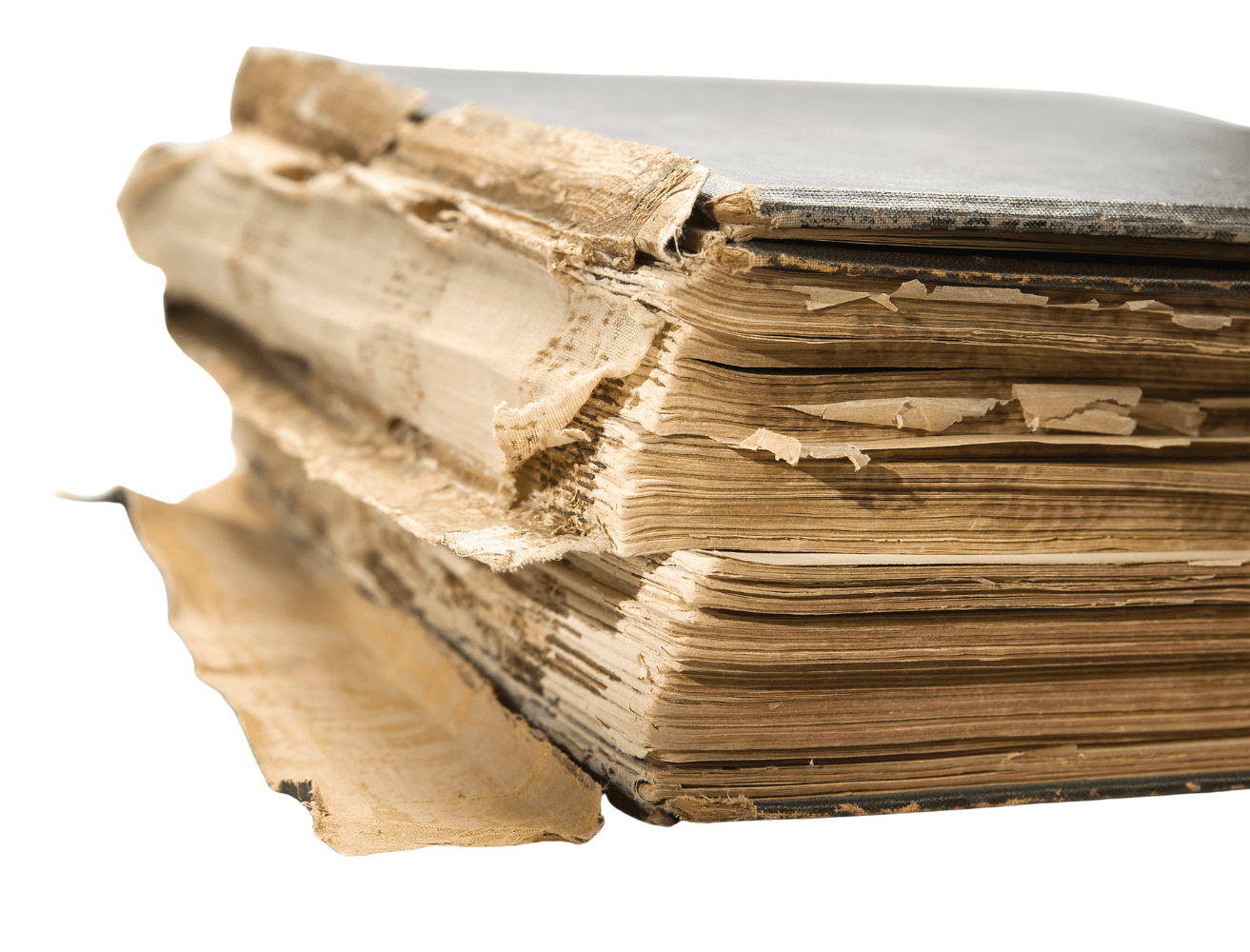
Choosing between non-destructive scanning of a bound volume or disbinding it for sheet-fed digitization impacts the entire project.
It’s not just a style choice; it’s a critical decision that decides if a rare ledger stays intact, if law firm files comply with retention rules, or if a university’s 10,000-volume project costs $50,000 instead of $500,000.
The global book digitization market reflects just how consequential this decision has become at scale.
The global automatic book scanner market is projected to grow at a CAGR of 4.0% through 2030, driven, notably, by rising institutional demand for high-precision, non-contact bound-volume imaging across libraries, government agencies, and archival organizations. (Source)
Meanwhile, around 60% of archival materials are already available in digital form, and over 55% of libraries and archives now use digital cataloging systems, figures that underscore how far digitization has moved from pilot initiative to operational standard. (Source)
Why Professional Assessment Comes First in Book Scanning?
Professional collection assessment comes first in every credible digitization project before scanning a single page. Skipping it risks damage, non-compliance, and massive costs. It’s the initial chain-of-custody step in ISO-certified workflows, guiding all method choices.
What Does a Thorough Assessment Check?
Qualified specialists inspect:
- Binding and structure: Sewn, glued, wire-bound, or fragile spines that limit opening angles.
- Paper condition: Age, brittleness, acid degradation, water damage—needing humidity control and special handling.
- Ink and media: Stability of pigments in manuscripts, color plates, or annotations to minimize light exposure.
- Format variations: Oversized pages, foldouts, maps requiring custom equipment.
Beyond Physical Traits, Assessments also cover:
- Institutional restrictions on handling, transport, or access.
- Confidential content for strict chain-of-custody.
- Output needs: Archival masters, searchable PDFs, court-admissible files, or print-on-demand—each demands unique specs.
A professional consultation from eRecordsUSA prevents errors in large-scale projects, saving thousands.
Professional Assessment Standard
FADGI’s Third Edition Technical Guidelines (May 2023) explicitly state that bound materials must not be opened beyond the point where the binding is stressed, and that in some cases, this means a volume cannot be imaged at all using standard equipment. This determination requires physical evaluation, not remote assumption. (Source)
What are the Two Book Scanning Methods and How Do They Differ in Process?
Destructive and non-destructive are two scanning methods for books. Let’s explore both of the book scanning methods in detail:
What is Destructive Book Scanning?
Destructive book scanning, which is also referred to as disbind-and-scan, cut-and-scan, or sheet-fed digitization, is the method by which a bound volume is physically disassembled before scanning.
- A precision hydraulic or guillotine cutter removes the binding spine, separating the volume into individual flat sheets.
- Those sheets are then fed through an automatic document feeder (ADF) or a high-throughput flatbed scanner at processing rates significantly faster than those permitted by bound-volume equipment.
- The resulting pages, now loose and flat, yield consistent, shadow-free scans with high geometric accuracy.
- The defining characteristic of this method is that it is irreversible.
Once a book is disbound, it cannot be reassembled. This is not a downside to be minimized; it is a factual constraint that must be acknowledged and deliberately authorized before a single volume is processed.
Destructive scanning is used responsibly only in these documented cases:
- Surplus or duplicate reference volumes with confirmed replacements.
- Periodical runs without preservation requirements.
- Organizations are consolidating space permanently.
- Academic presses are digitizing back-catalog editions for republication.
- Government or municipal archives handling records past the retention period
Critical Protocol Note
A professional digitization service will obtain explicit, written client authorization before applying destructive methods to any volume. No item should ever be disbound based on verbal instruction or volume-level assumption. Written authorization is not optional — it is the standard of care for any ISO-certified operation handling collections on behalf of institutions, estates, or legal entities.
What is Non-Destructive Book Scanning?
Non-destructive book scanning, also referred to as spine-safe scanning, non-invasive digitization, or bound-volume imaging, is the method by which a book or bound volume is digitized without any physical alteration to its structure.
- The volume is placed in a V-cradle or on an adjustable overhead book cradle that supports the spine at a controlled, structurally safe opening angle.
- An overhead planetary scanner, positioned above the open book rather than pressing it flat against a platen, captures each page spread using a high-resolution camera array and purpose-designed LED lighting engineered to minimize shadow at the gutter.
- No pages are removed. No spine is cut. No binding is stressed beyond what the physical structure of the volume can safely accommodate.
- The original is returned to the client in the same condition it arrived in, a commitment enforced through a documented chain-of-custody from intake to return.
For rare books, antique volumes, legal and corporate bound records, state libraries, religious texts, architectural folios, genealogical registers, manuscript collections, institutional archives, and any bound material where the physical original must be preserved alongside the digital record, non-destructive scanning is the only professionally appropriate method.
How Does Scanning Method Affect Image Fidelity, Gutter Correction, and OCR Accuracy?
The method you choose upstream determines image quality, searchability, and research utility downstream.
How Professional Equipment Resolves The Gutter Distortion Problem?
The most significant technical challenge in non-destructive book scanning is one that no competing digitization guide discusses with any depth: Gutter distortion.
When a bound book is opened and placed for imaging, the pages near the spine curve inward toward the binding. This curvature produces two distinct quality problems.
- First, it creates a geometric distortion: text near the gutter appears stretched, compressed, or angled, making those lines difficult or impossible to read accurately in both the raw scan and any downstream OCR output.
- Second, the curved surface catches shadow from the binding, producing a dark band across the inner margin that further degrades legibility.
Professional-grade equipment addresses this at three levels simultaneously.
- At the hardware level, Adjustable V-cradles and angled book cradles hold volumes at a controlled 90–120° angle. This minimizes page curvature without stressing the binding.
- Overhead planetary scanners use dual-LED lights at precise angles. They eliminate gutter shadows and provide even page illumination.
- At the software level, curve-flattening algorithms analyze each page’s geometry in software. They apply corrections to straighten baselines and restore accurate text shape.
Deskewing corrects residual page angle; keystone correction addresses perspective distortion from camera angle; and adaptive contrast normalization compensates for any remaining shadow gradient across the page surface.
Destructive scanning, by contrast, produces pages that lie completely flat, eliminating gutter distortion by design. This is a genuine technical advantage of the disbind-and-scan method for collections where physical preservation is not required, and it should be acknowledged as such.
- Flat pages produce consistent, geometrically accurate scans with uniform illumination and no shadow correction requirements.
- For high-volume periodical runs, surplus reference collections, or back-catalog republication projects, this throughput and consistency advantage is real and meaningful.
What separates a professional digitization service provider like eRecordsUSA from a commodity scanning vendor is the ability to get the same high-quality, accurate results with 100% audited results from non-destructive scans through strict post-processing.
eRecordsUSA services apply fixes consistently to huge collections of thousands of books, without losing quality at scale. They handle everything in-house, with documented quality checks at every stage of the batch process, unlike outsourced work, where you can’t verify consistency.
How Scanning Method Affects OCR Accuracy and Text Searchability?
OCR – optical character recognition is what transforms a scanned book page from a photograph into a searchable, indexable digital document. For most institutional clients, the searchability of the output is not a secondary consideration; it is the primary deliverable.
A 5,000-page bound archive that cannot be searched by keyword has limited research utility regardless of image resolution.
OCR accuracy is not primarily a function of the software engine. It is a function of input image quality. And input image quality is directly shaped by the scanning method and the quality of post-processing applied before OCR is run.
- Destructive scanning, producing flat, shadow-free, uniformly aligned pages, yields the highest baseline OCR accuracy for clean printed text – professional services typically achieve 99%+ character accuracy on modern printed materials processed via sheet-fed methods.
- Non-destructive scanning, while producing equally high-resolution images, introduces the variables described above — residual curvature, gutter shadow, and page angle variation that must be corrected through pre-processing before OCR is applied.
The professional pre-processing pipeline for non-destructive scans before OCR includes:
- Deskewing to correct page tilt and establish horizontal text baselines;
- Shadow removal to eliminate dark regions that OCR engines interpret as characters or noise;
- Noise reduction to clean scanner artifacts and paper texture that interfere with character recognition; and
- Adaptive contrast normalization to compensate for faded or uneven ink across aged paper.
When this pipeline is applied correctly and reviewed at quality assurance checkpoints, non-destructive scans of clean printed text achieve OCR accuracy within 1 to 2 percentage points of sheet-fed output.
For institutional clients — particularly law firms, research organizations, and government agencies across the Greater SF Bay Area, the applicable quality standard is now explicit.
All organizations submitting permanent records to the National Archives and Records Administration (NARA) or the Library of Congress must meet FADGI guidelines, with a minimum 3-star rating required for textual records, which mandates scanning at a minimum of 300 DPI in uncompressed TIFF format.
Four-star archival master quality requires a minimum of 400 DPI. These are not aspirational standards; they are compliance thresholds for institutional submissions.
Understanding the technical quality implications of each method is not an academic exercise. It is how institutional clients evaluate whether a digitization service will produce output that meets their actual research, compliance, and operational requirements.
Side-by-Side Comparison: Method, Quality, Cost & Use Case
| Dimension | Non-Destructive (Spine-Safe) | Destructive (Disbind-and-Scan) |
|---|---|---|
| Physical Impact | Zero — original returned intact in identical condition | Irreversible — binding removed, volume cannot be reassembled |
| Equipment Used | V-cradle, overhead planetary scanner, dual-LED lighting | Precision spine cutter, ADF / high-throughput sheet-fed scanner |
| Gutter Distortion | Present — requires post-processing correction (curve-flattening, deskewing) | Absent — flat pages produce consistent, distortion-free captures |
| Baseline OCR Accuracy | 99%+ on clean text post-correction; 85–98% on aged material | 99%+ on clean modern printed text; highest baseline for sheet-fed |
| Throughput Speed | Slower — operator handling per spread; 200–500 pages/hour | Faster — automated feeding; 1,000–3,000+ pages/hour |
| Per-Page Cost Range | $0.50–$1.50/page (standard); higher for fragile volumes | $0.10–$0.50/page; bulk rates scale lower at volume thresholds |
| Ideal Collection Types | Rare books, estate libraries, manuscripts, religious/genealogical volumes | Surplus volumes, periodicals, back-catalog editions, space-consolidation |
| Chain-of-Custody | Full documentation through return — required for legal context | Full documentation through disposition — written client authorization required |
| Post-Scan Disposition | Volume returned intact; pickup/delivery across SF Bay Area | Certified shredding with documentation, or return of loose pages |
| FADGI Compliance | Achievable at 3-star/4-star with planetary equipment | Achievable — disbound pages treated as standard document scanning |
| Authorization Required | Standard project authorization | Explicit written client authorization before disbinding |
When to Choose Non-Destructive Scanning?
Non-destructive scanning is ideal for more scenarios than you might think.
Key use cases include:
- Rare and limited-edition books: Never disbind if provenance, condition, or collector value matters, no matter the project scale.
- Legal and corporate records: Ledgers, minute books, bound correspondence, and court files need intact originals plus certified digital copies for audits, retention, and evidence.
- Estate libraries: Multi-generational provenance affects inheritance value—handle non-destructively as a fiduciary duty.
- Cultural and historical items: Religious texts, genealogical registers, and manuscripts hold irreplaceable significance beyond their cost per page.
- University special collections: Institutions from UC Berkeley to UC Santa Cruz follow strict policies against destructive processing of primary sources.
In the San Francisco Bay Area—home to top research universities, law firms, estates, cultural groups, government archives, and tech/biotech firms—demand for preservation-grade bound-volume digitization is sky-high.
Our 20+ years of ISO-certified, in-house processing with a full chain of custody ensure reliable bulk-scale results.
When Destructive Scanning Makes Sense?
Destructive scanning works best when preservation needs are fully met—not just assumed. It’s efficient for non-valuable duplicates.
Ideal scenarios:
- Surplus institutional copies: Confirmed replacements exist, and the owner waives physical retention.
- High-volume reference libraries: Deaccession superseded collections during space consolidation, with no preservation rules.
- Out-of-print publications: Academic/commercial presses use it for back-catalog digitization, print-on-demand, or republication—getting flat, high-accuracy scans.
- Expired government records: Past statutory retention, with disposal authority.
Professional safeguards:
- Pre-project volume review flags preservation risks for your approval.
- Precision disbinding with clean cuts (hydraulic/guillotine), not tearing.
- Page-order checks, batch quality control, and certified destruction docs (or page returns).
This ensures responsible, high-quality destructive scanning.
What Is Hybrid Book Scanning & When Do You Need It?
Hybrid book scanning mixes non-destructive and destructive methods for large, mixed collections. Most aren’t uniform—pro pros assess and segment them precisely, avoiding binary “all or nothing” choices that waste money or risk preservation.
Why Hybrid for Real-World Collections?
Simple advice fails big projects. Instead:
- University libraries: Scan 4,000 rare editions, faculty letters, and histories non-destructively—while disbinding 12,000 surplus journals for efficiency.
- Law firms: Preserve bound case files intact; destructively scan replaceable digests and guides.
- Estates: Non-destructively handle heirlooms and first editions; disbind expendable references.Using one method for everything? Too costly or risky.
How Hybrid Workflows Work?
- Pre-scan assessment: Check each volume/batch using clear criteria—binding condition, paper age, replacement status, client rules.
- Smart routing: Preservation items go non-destructive (full chain-of-custody). Expendables go disbind-and-scan for speed/cost.
- Unified management: Single intake, tracking, quality checks, timeline, and delivery—one archive, no hassle.
This delivers efficient, preservation-smart digitization at scale.
Make the Right Scanning Choice Today
Your bound collections deserve digitization that balances preservation, compliance, cost, and quality. Don’t risk damage, delays, or sky-high bills with guesswork.
Ready for bulk-scale results? Contact eRecordsUSA now for a free professional assessment. We’ll review your volumes, recommend the optimal hybrid workflow, and deliver ISO-certified archives fast. Call us today at 1.510.900.8800 or write to us at he***@*********sa.com to preserve what matters most and streamline the rest.