
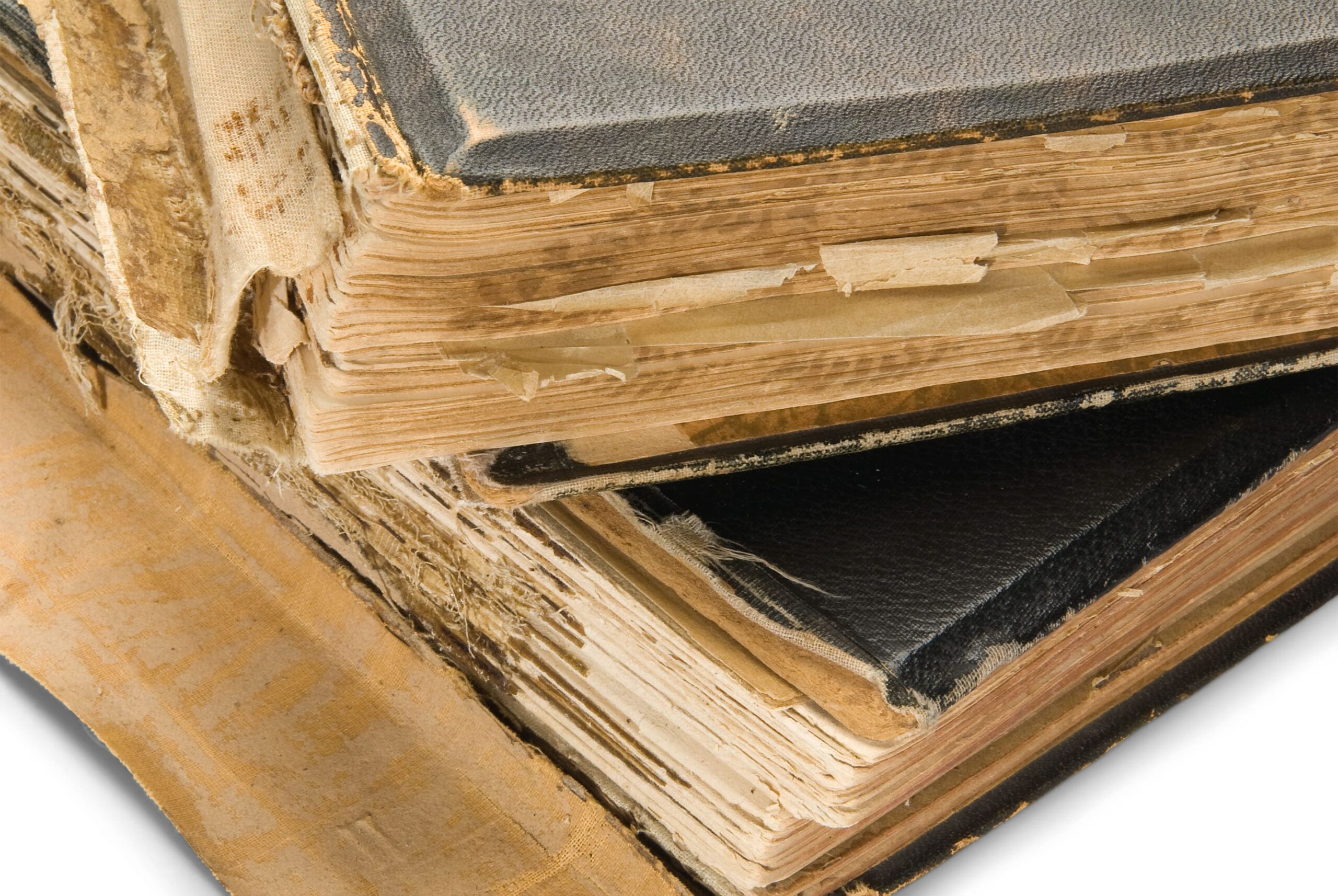
Preservation-grade digitization begins with protecting what holds the record together.
The National Archives holds more than 13.5 billion pages of historically valuable records — yet as of 2024, fewer than 300 million of those pages have been digitized and made available online. (Source)
That means the overwhelming majority of the nation’s analog archives remains accessible only through in-person visits or requests for physical reproductions.
For government agencies, law firms, county recorders, corporate archives, and university special collections across the San Francisco Bay Area and Sacramento, this gap between physical records and digital access is not an abstract national statistic. It is an operational reality measured in shelf-feet of unreachable bound volumes.
The challenge is not simply scanning. The challenge is scanning correctly: capturing every page at preservation-grade quality without introducing mechanical stress to binding structures that may have held for decades or centuries.
This guide addresses the full professional process for digitizing bound volumes without damaging the spine. From binding-type classification and pre-scan conservation triage, through capture quality control, FADGI-compliant output standards, long-term digital preservation, and the California regulatory framework that governs institutional digitization across San Francisco, Oakland, San Jose, Sacramento, and the surrounding counties.
Let’s start exploring from scratch.
What is a Bound Volume?
A bound volume is a set of individual pages, including handwritten, typed, or printed, permanently joined along one edge by stitched thread, adhesive, or both, and enclosed within protective covers.
Common examples include ledgers, deed books, minute books, court registers, assessment rolls, and institutional record books that served as the primary format for official recordkeeping before digital systems existed. Because the pages cannot be separated without destroying the object, the method of digitization is inseparable from the preservation of the volume itself.
What Binding Type Does Your Bound Volume Have & Which Scanner Does It Require?
Every binding structure carries a different risk profile and demands a specific equipment response.
No single scanning methodology applies universally to bound books/volumes. The binding structure is the governing variable:
- It dictates the maximum safe opening angle,
- The cradle configuration required,
- The appropriate scanner type, and
- Whether non-destructive digitization is viable at all without prior conservation stabilization.
For bulk institutional collections, mismatching equipment to binding type is the single most common source of both physical damage and degraded image quality.
Case-bound Volumes and the Overhead V-Cradle Book Scanner Standard
Case binding – The standard format in modern government registers, corporate minute books, and administrative ledgers common across county agencies is the most compatible format for overhead V-cradle book scanners.
These scanners capture images from above while the volume rests in an adjustable cradle that limits the opening angle to 90–120 degrees, eliminating the flatbed glass pressure that fractures adhesive bonds.
Before the cradle angle is set, adhesive integrity must be confirmed at intake: a binding that looks intact may already have subsurface adhesive failures that a forced angle will propagate.
Perfect-bound Archives and the Single Point of Structural Failure
Corporate records and administrative volumes produced are typically perfect-bound, meaning the pages are held together only by a strip of glue at the spine.
Over time, that glue dries out and becomes brittle. Opening the volume too wide, even slightly past its natural position, puts stress on that glue and causes pages to crack away from the binding.
To prevent this, these volumes are scanned at the smallest safe opening angle, with extra support placed under each page, and the glue strip is inspected for signs of weakness on every volume before scanning begins.
Sewn Bindings in Historical Deed Books and Legal Registers
Some older bound volumes, particularly historical deed books, church records, and notarial registers, are held together with hand-stitched thread rather than glue. Government offices hold large collections of these sewn registers. Stitched bindings tend to open more naturally than glued ones, but the thread itself is the weak point.
Over time, thread fibers break down quietly; a volume can open without any sign of strain and still suffer permanent internal damage to its stitch structure.
For this reason, every sewn binding is examined under magnification before scanning begins, so the right cradle angle can be set without putting stress on already-weakened thread.
Vellum and Limp-Bound Records: Why Some Covers Cannot Touch a Scanner
Vellum, a cover material made from prepared calfskin, was commonly used on official records before the 19th century. Vellum is highly sensitive to changes in room humidity and temperature. A cover that looks perfectly flat at intake can begin to warp or buckle within minutes of being handled in a different environment, which shifts every page beneath it out of position.
When a binding is too fragile or too stiff to open safely beyond a 60-degree angle, the volume is captured using an overhead camera rig – a system where nothing touches the book at any point during scanning.
Leather-Spine Volumes and Red Rot: When a Volume Cannot Be Scanned At All
Many legal, municipal, and church archive volumes across the Greater Bay Area and Sacramento were bound in half-leather or full-leather covers. A common condition in these older leather bindings is red rot – a deterioration process where atmospheric pollution causes the leather to break down into a reddish, powdery residue.
Beyond damaging the cover itself, red rot powder contaminates the pages inside, nearby volumes on the shelf, and the scanning equipment it comes into contact with.
Any volume showing active red rot is immediately set aside. It does not move to any scanning equipment until a conservator has stabilized the leather in writing, typically using a leather consolidant treatment that stops the deterioration before handling continues.
Accordion Fold, Guard Books, and Oversized Records: Why They Need a Different Machine Entirely
Surveying records, property plat maps, oversized assessment registers, and large-format archive volumes cannot be placed in a standard V-cradle book scanner. They are simply too large, and forcing them into a standard setup would damage them.
These materials are scanned using a planetary scanner: a large-format overhead imaging system where the document lies completely flat on a surface and a high-resolution camera captures it from above, with no pressure, no folding, and no contact with the binding at any point.
Every oversized format requires its own equipment configuration. There is no universal setting that transfers from one format to the next.
What Must Be Assessed and Resolved Before a Bound Volume Enters the Scanning Queue?
Digitization is a handling event, and that handling must be preceded by a formal, documented condition review against a defined trigger list.
Proceeding without it is not a time-saving measure: it is an unmanaged liability.
Six Conservation Triggers That Halt Digitization Until Resolved
- Active mold or foxing — fungal spores spread through handling and cross-contaminate adjacent volumes and scanning surfaces.
- Detached boards or broken hinges — a structurally separated cover cannot be positioned in a V-cradle without displacing the binding further.
- Red rot on leather-spine volumes — powdery leather particulate contaminates pages and equipment; leather consolidant stabilization must be confirmed in writing first.
- Water tideline damage — paper at tideline boundaries is frequently embrittled, making gutter tearing during page turns a high and documented risk.
- Extreme paper embrittlement — paper that fragments at page corners during preliminary inspection cannot withstand standard overhead scanning without active page loss.
- Insect or rodent damage — structural compromise from biological activity requires a documented conservation assessment before any digitization event is scheduled.
Once a bound volume clears all six conservation triggers, three additional intake standards govern how it is handled, documented, and prepared before a single scan is made.
How Is Chain-of-Custody Documentation Used at Intake for Bound Volume Digitization?
ISO-certified workflows require a documented condition record for every bound volume at intake before processing begins.
For California state agencies in Sacramento and county departments across the Bay Area subject to the State Records Management Act, this record is a legally relevant document: it establishes the physical condition of official records at the precise point they entered the scanning provider’s custody.
If any dispute arises later about the pre-existing state of the materials, an accurate intake log protects both the institution and the provider.
Should Cotton Gloves Be Worn When Handling Bound Volumes for Archival Scanning?
Cotton gloves should not be used when handling paper-based bound volumes for scanning. Bare, clean, dry hands are the current professional standard; they provide the tactile sensitivity needed to detect page resistance before a tear occurs.
Cotton gloves reduce dexterity, and their fibers can snag on deteriorated page margins, causing the very damage they are meant to prevent.
Nitrile gloves apply only to photographic materials, vellum, parchment, and silver gelatin surfaces, where skin oils are a direct preservation concern.
The assumption that cotton gloves are universally required is a widely repeated procedural error that both the Library of Congress and TownsWeb Archiving have explicitly addressed in their handling guidance.
What Page Turn, Support, and Environmental Standards Apply During Bound Volume Capture?
Pages are turned slowly, supported from beneath, and never forced. Resistance during turning is a diagnostic signal that halts the scan, not an obstacle to push through.
Foam bolsters, book snakes, and polyethylene foam wedges are placed on both sides of the open volume to prevent spine over-flexion during the dwell period while each image is captured.
Work surfaces are clean, temperature-stable, and low-humidity. Dust is removed from covers before opening — and always away from the pages, never inward.
How do Gutter Distortion and Lighting Failures Corrupt Bound Volume Scans at Scale?
An uncorrected gutter and uncontrolled lighting are not cosmetic failures; they are embedded legibility and OCR errors that scale with every volume in the collection.
Two capture-quality variables:
- Gutter curvature and
- Lighting control, which determines whether a digitized bound volume produces a usable, searchable institutional asset or an image repository that requires manual review of every page. Both are governed by physics. Both are controlled at the equipment and protocol level before capture begins. Neither can be corrected in post-processing without altering document content.
How Does Gutter Curvature in Bound Volume Scanning Degrade OCR Accuracy?
- When a bound volume is opened, the binding tension curves the pages inward toward the spine.
- This curvature zone. The gutter causes text nearest the binding to appear compressed, curved, or partially shadowed in the captured image.
- When OCR is applied to gutter-distorted images, characters in this zone are systematically misread, compressed into unrecognizable sequences, or omitted entirely.
- Across bulk institutional collections spanning hundreds or thousands of bound volumes, uncorrected gutter distortion produces thousands of corrupted, unsearchable pages.
The functional value of any digitization investment is directly proportional to the percentage of content that OCR can accurately process.
What are the Three Professional Methods for Correcting Gutter Distortion in Bound Volume Scanning?
Gutter distortion in bound volume scanning is corrected using three sequential methods applied at the source, at the point of capture, and after capture.
- Adjustable cradle angle – The scanning cradle is configured to the volume’s natural resting position rather than forced to a fixed standard angle, reducing page curvature at the source before any image is captured.
- Low-pressure glass screen – For overhead scanners equipped with a glass platen, a featherweight panel gently flattens the open page surface in the gutter zone without applying mechanical stress to the spine. The pressure is calibrated to flatten the curve without compressing the page.
- Post-capture algorithmic dewarping – Image processing tools, including ABBYY FineReader, ScanTailor, and purpose-built archival correction platforms. Apply page-curve correction to every image after capture, restoring geometric accuracy to gutter text before the OCR engine processes the file.
Dewarping is applied per image rather than as a batch parameter, because curvature varies naturally across a volume, and a single uniform correction value will over-correct some pages and under-correct others.
What Lighting Standard Is Used for Professional Bound Volume Scanning?
Bilateral diffuse lighting is the standard lighting configuration for professional bound volume scanning.
- Light sources are positioned on both sides of the scanning head, eliminating gutter shadow and removing specular hotspots from glossy or coated page surfaces. This is a hardware-embedded property of institutional scanning equipment — not a software setting and not a post-capture adjustment.
- The lighting architecture of a vendor’s equipment should be verified as a procurement requirement, not assumed after a contract is signed.
When Is Raking Light Used During Bound Volume Digitization?
Raking light – angled, directional illumination is used when the document surface carries physical information that standard diffuse lighting cannot reveal.
Embossed seals, impressed text, relief stamps, notarial stamps, and wax impressions are all surface features that diffuse lighting flattens into invisibility.
Raking light reveals the surface topography of these features by casting controlled directional shadows across them. Without it, this category of information is entirely undetectable in a standard scan and permanently lost from the digital record.
When Is Infrared Imaging Used to Capture Text in Damaged Bound Volumes?
Infrared imaging is used when visible-light capture cannot reproduce the text. It is warranted for bound volumes with iron gall ink corrosion, water damage obscuring text, severe ink fade, or deliberate cancellation over content that must remain legible.
Iron gall ink — the dominant writing medium in Western records through the 19th century and into the 20th corrodes the paper support as it oxidizes, eventually creating voids where the most heavily inked text once was. Infrared imaging penetrates surface damage and ink degradation to reveal underlying text that no other capture method can recover.
Why Do Consumer Camera Setups Fail for Archival Bound Volume Scanning?
Consumer camera setups – table lamps, room fluorescents, and on-camera flash produce three unresolvable capture failures:
- Gutter shadow,
- Specular glare, and
- Uneven exposure across the page surface.
None of these can be corrected in post-processing without altering document content. Brightening a shadowed gutter erases faint ink. Increasing contrast to compensate for uneven exposure obscures fine detail. Consumer camera rigs do not offer a cost-effective alternative to institutional scanning equipment; they produce simultaneously damaged physical volumes and degraded digital images, with no recovery path for either.
What are the Eight Stages of a Professional Spine-Safe Bound Volume Digitization Workflow?
A structured, documented workflow is the operational foundation of accountable archival scanning at any volume.
Stage 1 — Intake and Chain-of-Custody Logging
Every volume is logged at intake with condition notes, binding classification, physical dimensions, and page count. Chain-of-custody documentation opens at this stage and closes only upon confirmed return of the physical volumes.
Confidentiality agreements are executed at intake before any physical access to volume contents for government records, legal archives, and corporate materials subject to privacy obligations.
Stage 2 — Conservation Triage Against the Six-Point Trigger Checklist
Every volume is assessed against the six conservation triggers established in Section 3. Volumes flagged for stabilization are quarantined from the active scanning queue and documented with the specific trigger condition and the required intervention.
No flagged volume advances until stabilization is confirmed in writing by a qualified conservator or the project supervisor.
Stage 3 — Binding Classification and Protocol Assignment
Each volume receives a documented protocol assignment: equipment type, cradle angle or camera rig configuration, page turn method, and lighting configuration, all determined by binding classification per the framework in Section 2.
This assignment is recorded in the project file and governs every subsequent stage. For bulk collections with mixed binding types, a binding-type inventory is produced at this stage to support equipment configuration planning.
Stage 4 — Equipment Calibration to the Largest Volume in the Batch
The scanner is calibrated to the largest volume in the batch before any production capture begins. Color calibration targets are recorded at the start of every session. ISO-certified workflow requires calibration records for every project.
Stage 5 — Controlled Capture with Operator Oversight at Every Page
In-house scanning with trained operator oversight at every page. Cradle angle is adjusted per volume within the batch. Gutter curvature is monitored in real time. Pages that resist turning pause the scan; they are flagged for review, not forced.
No throughput target overrides physical handling protocol at any stage. This is the principle that distinguishes preservation-grade scanning from high-volume document processing: the scan serves the record, not the production schedule.
Stage 6 — Post-Processing: Dewarping, Deskewing, and Completeness Verification
Every image is corrected for gutter distortion via algorithmic dewarping and for rotational skew via deskewing. Brightness is normalized across the full image set without altering content — no brightening that erases faint ink, no contrast adjustment that obscures fine marginalia. Completeness is verified against the intake log: every page of every volume is accounted for before the batch advances. Quality control is performed on 100% of images for institutional-grade projects — not on a statistical sample.
Stage 7 — OCR Processing, Metadata Embedding, and Output Formatting
OCR is applied to all corrected images. Metadata is embedded per client-specified schema. Output is formatted to specification: searchable PDF, PDF/A (ISO 19005), TIFF, or JPEG2000. Bookmarking and hierarchical indexing are applied for large-volume deliverables. File naming follows a structured convention established at intake and applied consistently across every file in the deliverable.
Stage 8 — Final QC Review and Verified Institutional Return
The complete deliverable is verified against the intake log before release: every volume, every page, every output file confirmed. Chain-of-custody documentation is completed and returned with the deliverable. Physical volumes are returned.
What FADGI Star Rating and Archival Output Format Should California Institutions Specify for Bound Volume Digitization?
A raw scan is source material — a FADGI-compliant, post-processed, metadata-embedded file is the preservation asset.
The Federal Agencies Digital Guidelines Initiative, known as FADGI, defines the United States quality benchmark for digitization through a two-to-four star rating system that measures resolution, tonal response, color accuracy, and noise for reflective materials, including bound volumes.
Its Technical Guidelines for Digitizing Cultural Heritage Materials, third edition, published in May 2023 and maintained by the Library of Congress, removed one-star specifications for rare and special collections categories entirely, raising the effective minimum quality floor for any historically significant bound volume digitization project.
- Two-star quality is appropriate only for routine administrative records with no ongoing preservation obligation.
- Three-star is the minimum standard for institutional archival collections, including municipal records, county agency backfiles, law firm archives, and corporate records departments.
- Four-star preservation quality is required for rare, irreplaceable, or historically significant bound volumes, including pre-20th century deed books, superior court registers, state archive materials, and university special collections holdings.
Institutions must specify the required FADGI star rating in their procurement documents and require verifiable evidence in the form of calibration records, target measurements, and quality control logs, not vendor self-attestation.
ISO 9001 certification provides the documented process controls that FADGI compliance requires as its evidential foundation, because compliance without documentation is not compliance at all.
Once the standard is set, every image in the project is corrected for gutter distortion through algorithmic dewarping and for rotational skew through deskewing before any further processing occurs.
Brightness and contrast are then normalized consistently across the entire image set and across all volumes in a bulk run. This is because inconsistent normalization across a large archive produces an uneven deliverable where some volumes are clearly legible, and others are washed out or underexposed, and post-project correction at that scale is not operationally feasible.
For printed text in modern bound volumes, optical character recognition accuracy of ninety-eight to ninety-nine percent is achievable on correctly captured and processed images.
For historical handwritten records, the dominant content type in deed books, court minute books, and assessment registers, OCR accuracy varies by legibility, historical script style, and ink condition, and those benchmarks are communicated to institutional clients before a project begins, not disclosed after delivery.
Metadata is embedded in every file per the client’s specified standard: Dublin Core for most institutional archives and IPTC Core for image-heavy bound records, with mandatory elements including document title, origination date, source institution, chain-of-custody reference, and access or copyright notice.
File naming follows a structured convention established at intake and applied consistently, because automated repository ingestion systems depend on naming consistency to process metadata correctly.
The preferred master file format for long-term preservation is TIFF — an uncompressed format providing maximum image fidelity and broad institutional compatibility across county, state, and university repositories.
PDF/A, defined under ISO standard 19005, is the archival-grade format required for any official records subject to government records law, because it embeds fonts, metadata, and color profiles directly within the file rather than referencing external resources that may become unavailable over time.
Searchable PDF is the access-layer derivative generated from the PDF/A master for day-to-day reference and public access portals.
JPEG2000 is the wavelet-compressed archival format used by the Library of Congress and Internet Archive for large-scale digital repository integration. It is appropriate where that level of repository alignment is required.
When Is Disbinding a Bound Volume the Responsible Digitization Choice — and When Is It Never?
Disbinding is a documented last resort — never a default, never the vendor’s unilateral call.
Disbinding is the act of separating the pages of a bound volume from its binding structure to enable flatbed or sheet-fed scanning. It is irreversible. It permanently alters the physical object. It is never the first option and never the scanning provider’s unilateral decision. It is a documented, client-authorized action taken only after non-destructive alternatives have been formally assessed and found inadequate for a specific volume’s condition and content requirements.
Three Conditions Where Disbinding a Bound Volume May Be the Responsible Choice
- Binding adhesive failure has already progressed to active page detachment during controlled opening. When pages are separating from the spine during assessment, not during forced opening, disbinding under controlled conditions with individual page support may cause less additional structural damage than continued opening stress on an already-failed binding.
- The volume has no preservation value as a physical object. A duplicate administrative register, a photocopy-era bound printout, or an internal working reference retained solely for its text content, where the institution has confirmed in writing that the physical volume carries no ongoing access, legal, or historical value, may be appropriate for disbinding.
- Paper is more fragile at the binding channel than in the page field, and repeated gutter stress at the margin would cause more page loss than a single controlled disbinding operation with appropriate page support.
Disbinding is never a throughput efficiency measure, a solution to difficult binding types that simply require better equipment, or a decision made without explicit written client authorization.
Every decision made from intake through delivery is either a protection or a liability. When those decisions are made by a trained, accountable, in-house team working under ISO-certified workflows, the institution retains full visibility into every stage of the process and full confidence in the integrity of what is returned.
When they are made by a vendor who disburdens, outsources, or shortcuts, the institution absorbs the consequences — physical, legal, and archival, with no path to recovery.
Bound volumes are not replaceable. The records inside them are not reproducible. The standard of care they receive during digitization is the standard of care your institution’s history receives permanently.
eRecordsUSA is a locally owned and operated digitization facility serving institutions, government agencies, law firms, corporate archives, and bulk clients across the San Francisco Bay Area and Sacramento. With over 20 years of in-house experience, ISO-certified workflows, and a 5-star rated service record on Google and Yelp, every bound volume project is handled by a trained professional.
Free consultations and free bulk estimates are available for collections of any size. Multilingual support is offered in English, Hindi, Punjabi, Spanish, and Mandarin. The facility is wheelchair-accessible with free on-site parking.
Call us at 1.510.900.8800, or write us at [email protected] today to schedule your free consultation or request a bulk estimate for your bound volume digitization project.
Frequently Asked Questions About Bound Volume Digitization
Q1: Can bound volumes be picked up and returned, or does the client need to deliver them?
eRecordsUSA accepts both drop-off and scheduled pickup for bound volume digitization projects. Institutional clients across the SF Bay Area and Sacramento can arrange collection logistics during the free consultation.
Q2: How long does bound volume digitization take for a small collection of under 10 volumes?
Small bound volume collections of under 10 volumes are typically processed within 3 to 7 business days, depending on binding condition, required resolution, and output format. A confirmed timeline is provided at the consultation before any project begins.
Q3: Is bound volume scanning available for personal or family archive collections, not just institutions?
Yes. eRecordsUSA digitizes personal and family-bound archives, including heirloom ledgers, diaries, and estate records alongside institutional collections. The same spine-safe protocols, confidentiality standards, and free consultation apply to every project, regardless of size.
Q4: What happens if a bound volume is damaged during the scanning process?
eRecordsUSA’s ISO-certified intake documentation records every volume’s condition before scanning begins. Chain-of-custody logs protect both the client and the provider. Any pre-existing condition is documented at intake, and all handling follows conservation-grade protocols to prevent damage during the digitization process.