
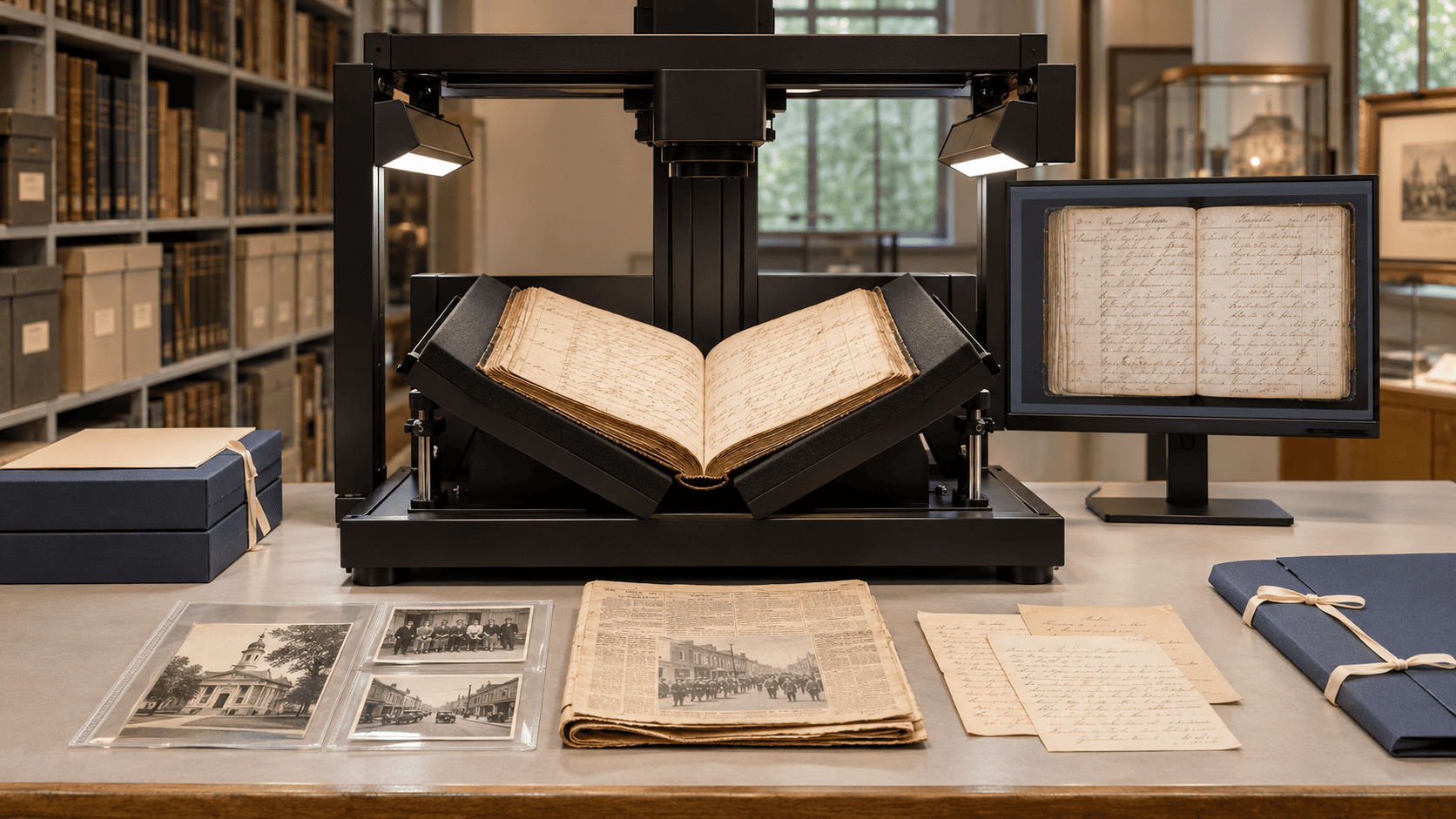
How can museums and historical societies digitize fragile archival collections without damaging the original materials or losing their historical context?
Aging newspapers, manuscripts, historical photographs, bound registers, and rare documents often require specialized handling before they can be made accessible for research.
Museum-grade digitization helps cultural heritage institutions create accurate digital records while reducing unnecessary handling of original materials and maintaining the information needed to identify and organize each item.
However, digitizing museum archives involves more than scanning pages.
Institutions must assess
- Collection conditions,
- Select suitable imaging methods,
- Establish quality requirements, and
- Determine how the resulting files will support research, exhibitions, and
- Archival access.
This guide explains what museums and historical societies should consider before starting an archival digitization project.
Quick Answer: How Does Museum-Grade Digitization Work?
Museum-grade digitization converts fragile historical documents, photographs, manuscripts, and archival collections into high-quality digital files using preservation-sensitive scanning methods.
The process involves assessing material condition, selecting imaging equipment, maintaining archival metadata, and verifying image quality. It helps museums and historical societies reduce unnecessary handling of original materials.
What is Museum-grade Digitization of Archival Materials?
Museum-grade digitization is the preservation-sensitive process of converting historical documents, photographs, manuscripts, and other archival materials into high-quality digital records while protecting the originals & maintaining their historical context.
Unlike routine office scanning, it considers
- Material fragility,
- Specialized imaging requirements,
- Archival metadata, and the
- Intended use of digital files.
Museum-grade digitization is not a single formal standard or certification. Institutions establish project-specific requirements using recognized guidance, including FADGI, and their own preservation policies and quality-control procedures.
The resulting digital collections can support historical research, educational programs, exhibitions, and remote access. They can also reduce repeated handling of vulnerable originals.
However, digitization does not replace physical conservation or eliminate the need to preserve historically significant artifacts.
Which Museum & Historical Materials Require Specialized Digitization?
Museum collections often contain materials of different ages, sizes, formats, and physical conditions. Each may require a different approach to capture its information or visuals.
Fragile Historical Documents, Newspapers & Manuscripts
Old newspapers, handwritten letters, correspondence, and historical records may contain brittle paper, faded ink, tears, or weakened folds.
Historical newsprint can be particularly delicate. Repeated unfolding or repositioning may increase the risk of damage, especially when the paper has become brittle.
Suitable imaging methods should accommodate the document’s condition without applying unnecessary pressure.
For materials that cannot safely pass through conventional equipment, overhead imaging or appropriately supported flatbed scanning may be considered.
Museums maintaining historical microfilm or microfiche collections may also require dedicated film scanning equipment to convert these records into digital images.
Bound Books, Registers & Archival Volumes
Rare books, institutional registers, ledgers, and bound manuscripts require attention to their bindings.
Forcing a historical volume completely flat can damage its spine, loosen pages, or place stress on weakened joints.
Planetary scanners, overhead imaging systems, and specialized book cradles can help support bound materials during capture.
The appropriate method depends on how safely the volume opens, its binding condition, and the position required to capture readable pages.
TheLibrary of Congress preservation guidelines specifically identify restricted bindings, detached spines, and loose joints as conditions that require assessment before digitization.
Historical Photographs, Maps & Oversized Records
Photographic prints, maps, architectural drawings, and oversized documents present different imaging challenges.
Historical photographs may require careful lighting and color reproduction to capture subtle visual details.
Large maps and blueprints may contain fine lettering, annotations, or intricate illustrations that must remain legible in the digital version.
Folded or rolled materials should be assessed before scanning rather than forced into a flat position.
Appropriate equipment must accommodate the object’s dimensions and physical characteristics without creating unnecessary stress.
Because these collections vary, institutions should establish digitization priorities and handling requirements before selecting their capture methods.
How Should Museums Prepare & Prioritize Collections for Digitization?
A museum digitization project should begin with a collection assessment.
This helps
- Staff identify materials that need special attention,
- Determine which records should be digitized first, and
- Establish the requirements for the completed archive.
Assess Collection Condition, Historical Value & Research Demand
Not every archival item requires immediate digitization.
Museums can prioritize collections based on three factors:
- Physical condition: Materials at risk of deterioration or damage from frequent handling.
- Historical significance: Rare, unique, or culturally important records that contain valuable information.
- Research demand: Collections frequently requested by researchers, educators, curators, or the public.
For example, a historical society may prioritize fragile newspaper issues that are regularly consulted for local research before digitizing more stable administrative records.
Museums should also identify copyright, donor agreements, and access restrictions that could affect how their digital records are distributed.
Preserve Original Collection Order and Archival Context
Historical information can lose important meaning when individual pages become separated from their original collection.
For example, a digitized newspaper page should remain associated with its publication title, issue date, and page number. Archival correspondence may need to retain its relationship to a particular folder, collection, or accession record.
Museums should therefore establish a consistent system for identifying materials before scanning.
This may involve inventory numbers, accession identifiers, collection titles, and original document sequences.
Maintaining these relationships allows researchers to understand where a record originated and helps museum staff connect digital files to their corresponding physical items.
Decide Between In-House and Outsourced Museum Digitization
Some museums can digitize selected collections using internal equipment and trained staff.
However, larger projects or collections with fragile bindings, oversized materials, or specialized imaging needs may exceed available resources.
Before choosing an approach, institutions should consider collection volume, staff expertise, equipment suitability, handling risks, and required digital deliverables.
Outsourcing may be appropriate when a project requires specialized scanning equipment, consistent quality control, or the coordinated digitization of thousands of archival pages.
If a professional digitization provider is involved, the museum should agree on handling restrictions, inventory tracking, file specifications, and delivery requirements before transferring materials.
These decisions establish the foundation for a controlled archival digitization process.
How Are Fragile Museum Archives Digitized Without Damage?
Preservation-sensitive archival digitization uses handling and imaging methods suited to each object’s condition. The objective is to minimize physical stress while producing accurate, usable digital records.
Safe Handling, Transportation & Chain of Custody
The condition and handling requirements of historical materials should be documented before being transported or scanned.
For outsourced projects, institutions should establish appropriate protective packaging, inventory records, and procedures for tracking items throughout the scanning process.
A documented chain of custody helps maintain accountability as materials move between collection storage, preparation, digitization, and return.
Some severely deteriorated items may require conservation assessment or stabilization before imaging can proceed safely.
Non-Destructive Scanning and Preservation-Quality Imaging
Non-destructive scanning aims to capture historical materials without unnecessarily altering their physical structure.
Depending on the object, this may involve overhead imaging, planetary scanners, custom book cradles, or carefully supported flatbed equipment.
Non-destructive does not always mean completely contact-free. The selected method should minimize physical stress while allowing the original material to be captured accurately.
Image quality is another important consideration.
Resolution, sharpness, color reproduction, lighting, and cropping can affect whether small text, illustrations, annotations, and other details remain visible in the resulting digital images.
TheFederal Agencies Digital Guidelines Initiative (FADGI) provides technical imaging guidance for cultural heritage materials, including textual records, maps, photographic prints, and negatives.
Its third edition, published in 2023, includes updated imaging practices and methods for evaluating digital image quality.
Museums can use this guidance to define appropriate capture requirements and review results against their project specifications.
However, no single resolution or imaging method is suitable for every archival collection.
Once the original materials have been captured, the next consideration is whether the digital files meet the institution’s requirements for preservation and access.
What Digital Files and Metadata Should Museums Receive?
Museums should define their required digital deliverables before scanning begins.
Different file formats, text-recognition capabilities, and metadata fields serve distinct purposes within an archival collection.
Preservation Master Files and Digital Access Copies
Preservation masters retain high-quality image information for institutional archiving, while access copies are designed for convenient viewing, sharing, or research.
Common formats include:
- TIFF: Frequently used for preservation master images because it supports uncompressed or losslessly compressed image data.
- PDF: Useful for organizing multi-page documents and providing convenient access to digitized publications.
- JPEG: Often suitable for online catalogs, websites, and other applications requiring smaller image files.
For example, a historical newspaper digitization project may deliver uncompressed TIFF master files alongside OCR-searchable PDFs for researchers.
The final format selection should reflect the collection type, intended use, and the institution’s digital preservation requirements.
OCR and Searchable Historical Documents
Optical Character Recognition (OCR) converts printed text in scanned images into machine-readable text.
For historical newspapers, printed registers, and archived publications, OCR can help researchers locate names, dates, places, and specific subjects without manually examining every page.
However, text recognition is not equally reliable across all materials.
Faded printing, damaged paper, unusual historical typefaces, and complex newspaper layouts can affect OCR accuracy.
Handwritten Text Recognition (HTR) may help process certain handwritten collections, but results depend on handwriting legibility, document condition, and the recognition method used.
Institutions should decide whether basic keyword search, corrected text, or detailed transcription is required before approving the digital deliverables.
Archival Metadata, Quality Control & Long-Term Access
Archival metadata connects digital files to their original records.
Depending on the collection, this information may include document titles, accession numbers, publication dates, collection identifiers, and page sequences.
Before accepting a completed project, museums should also verify that files are readable, correctly named, properly ordered, and consistent with the agreed specifications.
After delivery, museums remain responsible for managing their digital collections.
This includes appropriate storage, backups, access controls, and periodic integrity checks.
TheLibrary of Congress data integrity guidance explains how checksums and other fixity information can help detect unintended changes to digital files.
These measures support continued access to the collection after the original scanning project has ended.
How eRecordsUSA Digitized Campbell Historical Museum’s Newspaper Archives?
The Campbell Historical Museum in California needed to digitize its Campbell Press newspaper collection, which contained fragile newsprint and bound historical volumes.
The collection documented decades of local history, but brittle pages, faded printing, and inconsistent newspaper layouts created preservation and digitization challenges.
eRecordsUSA completed the project using a specialized flatbed archival scanning approach with custom cradles to accommodate vulnerable materials.
The project included:
- 6,509 newspaper pages digitized, including 1,460 pages from two bound volumes.
- Uncompressed TIFF master files for archival retention.
- OCR-searchable PDFs accompanied by ALTO XML text information.
- Structured file naming and metadata aligned with the museum’s requirements.
The published project documentation identifies a 300–400 ppi capture range, although its descriptions of color mode differ. The precise color specification is therefore omitted here pending confirmation.
The files were prepared to support the museum’s research activities, public access, and exhibition requirements.
The project demonstrates how specialized handling, organized metadata, and suitable file deliverables can help cultural heritage institutions make extensive historical collections more accessible.
Read the completeCampbell Historical Museum newspaper digitization case study to learn about the project’s challenges, scanning approach, and archival outcomes.
Plan Your Museum or Historical Archive Digitization Project
Historical collections require digitization methods that reflect their condition, format, and intended use.
At eRecordsUSA, our museum-grade digitization work supports museums, historical societies, and cultural heritage institutions seeking professional scanning of fragile documents, bound volumes, historical newspapers, and archival collections.
With experience in large-volume archival projects, including the Campbell Historical Museum newspaper collection, our team helps institutions evaluate their scanning requirements and prepare appropriate digital deliverables.
Explore ourhistorical document scanning services orcontact eRecordsUSA to discuss your collection and project requirements.
Frequently Asked Questions About Museum-Grade Digitization
Can Fragile Historical Documents Be Scanned Without Damaging Them?
Many fragile documents can be digitized using appropriate handling, physical supports, and preservation-sensitive imaging methods. Severely deteriorated materials may require conservation assessment or stabilization before scanning.
Should Museums Digitize Entire Collections or Prioritize Certain Records?
Museums can digitize complete collections or proceed in phases. Priorities should reflect physical condition, historical significance, research demand, available resources, and intended use.
Can Handwritten Historical Records Become Searchable?
Some handwritten records can be processed using Handwritten Text Recognition technology. Accuracy depends on handwriting style, document condition, and image quality. Manual transcription or review may still be necessary.
Do Museums Need to Keep Original Materials After Digitization?
Digitization does not automatically replace original historical materials. Physical objects may retain cultural, evidential, and research value beyond their informational content. Retention decisions should follow institutional policies and applicable requirements.
Can Digitized Archives Be Used for Research and Public Exhibitions?
Yes. Museums can use appropriate digital copies for research, educational programs, online collections, and exhibitions, provided that copyright, donor agreements, privacy restrictions, and institutional access policies permit those uses.


