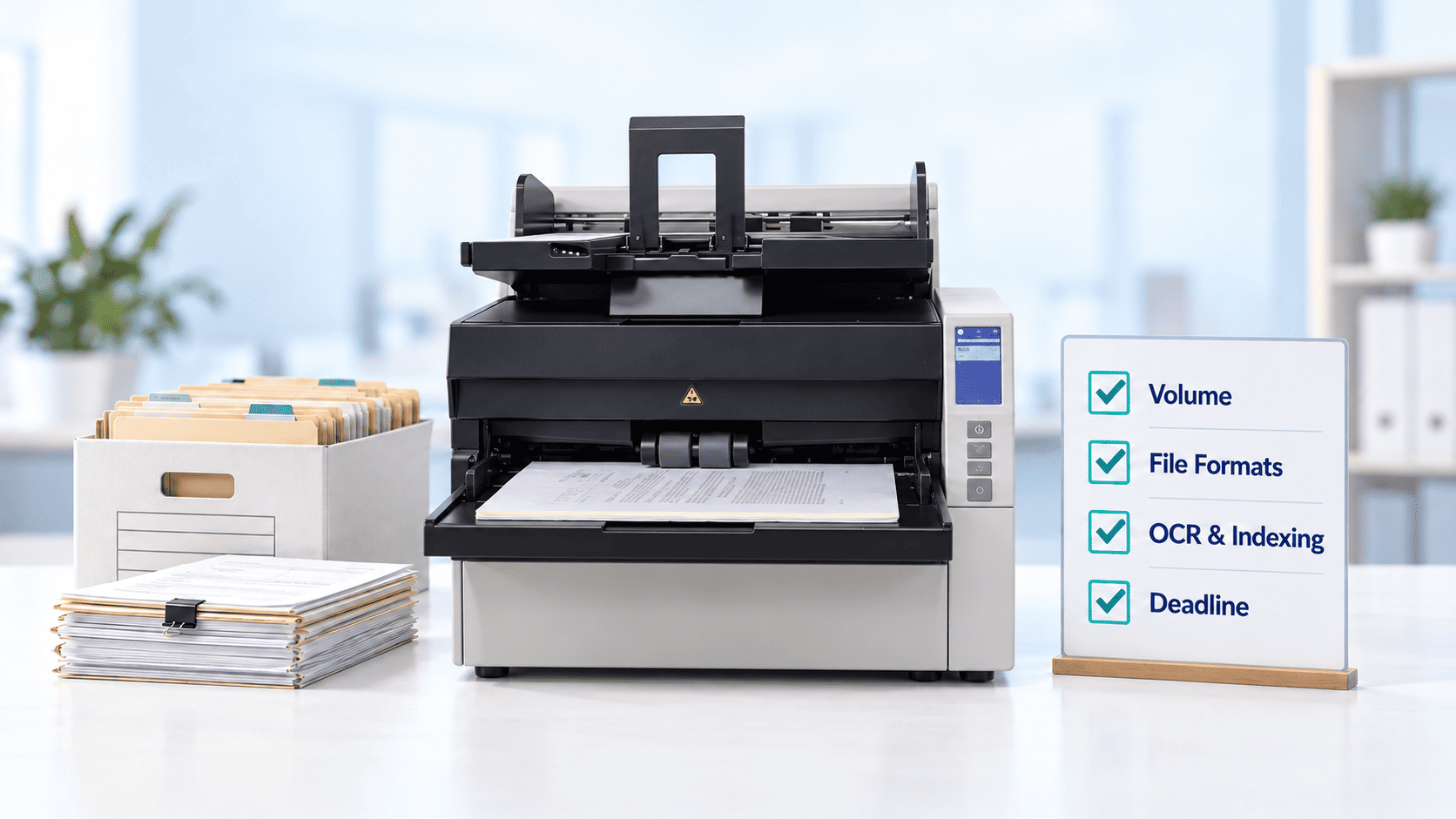
What details do you need for a document scanning quote? Do you need to know the exact page count, and what affects the cost of document scanning?
These questions often arise when an organization has banker’s boxes, file cabinets, folders, or archived records ready for digitization but does not yet have a complete project specification.
For an initial estimate, start with what you know:
- The approximate volume of records,
- How they are stored,
- The document types and physical condition,
- Any preparation involved, and
- The digital file formats you need after scanning.
You should also identify relevant OCR, indexing, security, pickup, record-access, and deadline requirements.
These document scanning quote requirements help a provider understand both the physical collection and the work required to convert it into usable digital records.
Two projects with the same number of boxes can require very different workflows if one contains uniform loose pages while the other includes binders, fragile records, mixed document sizes, detailed indexing, or restricted-access files.
An initial estimate can usually be based on approximate volume and representative information.
Final pricing may depend on a more precise inventory, sample review, test scans, or a confirmed scope for preparation, indexing, delivery, and original-record handling.
Quick Answer: What Information Do You Need for a Document Scanning Quote?
To request an accurate document scanning quote, provide the approximate record volume, storage method, document types and sizes, physical condition, preparation needs, OCR and indexing requirements, preferred file format, record location, security or access restrictions, project deadline, and instructions for the original documents after scanning.
If you do not know every detail, provide the information you have. The scanning provider can identify what else needs to be confirmed before finalizing the scope and pricing.
What Information is Needed for a Document Scanning Quote?
A useful quote starts with three things:
- what type of physical records you have,
- what digital file format you need, and
- how the project must be handled.
Document scanning costs can vary based on record volume, document preparation, document size, single-sided or duplex capture, grayscale or color scanning, fragile or bound materials, OCR, indexing, file naming, quality-control requirements, pickup or delivery, security needs, turnaround time, and what should happen to the originals after scanning.
Mixed collections may also require separate workflows for different record types. That is why an accurate quote depends on the full project scope, not page count alone.
Document Volume & Storage Method
Start by describing how much media needs to be scanned.
If you know the approximate page count, provide it. If you do not, describe the records using the physical units you already work with, such as:
- Bankers boxes, type, size and number of boxes.
- File cabinets, types, number of drawers,
- Folders, binders, or number of shelves
- Linear length of stored records
NARA provides a general reference of approximately 2,500 pages per cubic foot. Treat this as a rough estimate rather than a universal box-to-page conversion. The actual number can vary substantially depending on folder thickness, paper weight, inserts, packing density, and how full the containers are.
If records are stored across multiple offices or facilities, identify the quantity at each location rather than giving only one combined total. This helps the provider understand both the scanning volume and the logistics involved.
Once the approximate quantity is clear, the next step is to describe what is actually inside the boxes, cabinets, or folders.
Document Type, Condition & Preparation
A box of uniform, loose letter-size pages differs from a box containing binders, file folders, folded forms, damaged paper, photographs, oversized sheets, or mixed document formats.
Describe the typical material in the collection and identify anything that falls outside that pattern.
Relevant details may include:
- Loose sheets versus folders or binders
- Letter, legal, oversized, or mixed-size documents
- Staples, paper clips, fasteners, or attachments
- Folded, torn, brittle, stained, or fragile pages
These characteristics matter because some records may require preparation before scanning. Pages may need to be removed from binders, separated, unfolded, or routed through a different capture workflow.
You do not need to inspect every sheet individually. A more useful approach is to describe the typical record and then identify significant exceptions.
For example:
95 boxes of standard office files and 5 boxes containing oversized or bound documents are more useful for scoping than simply stating 100 boxes of records.
Once the provider understands the physical collection, the quote can account for what the digital records need to do after capture.
What Digital Output Requirements Should You Provide?
Scanning creates digital images of paper records, but most business projects require more than page images alone.
The files may need to be searchable, named according to an existing convention, indexed with specific information, organized into folders, or prepared for use within another records system.
Defining these requirements early helps the provider understand the intended deliverables, rather than making assumptions about how the files will be used.
-
OCR, Indexing, File Naming. Metadata Capture & File Organization
Tell the provider whether the scanned documents need to be searchable.
Optical character recognition, or OCR, identifies printed characters within scanned page images and converts them into machine-readable text.
OCR can make printed documents searchable, but accuracy depends on the source material, language, layout, image quality, handwriting, text size, and document condition.
An older NARA technical report states that agencies should use at least 300 dpi for office documents when OCR or other future applications are anticipated. Detailed drawings, maps, and fine-line materials may require different settings.
For commercial projects, 300 dpi is often a starting point for standard office documents, but the scanning provider should confirm the appropriate resolution after considering text size, contrast, condition, color, intended use, and representative samples.
Next, tell the provider how the digital records need to be identified.
If files must be associated with information such as an employee name, client number, invoice number, case number, record date, or document type, identify those required fields when discussing the quote.
The same applies to file naming and folder structure.
For example:
- Scan each employee folder into a separate searchable PDF and name the file using the employee ID.
- Provides significantly more project information than:
Scan the folders as PDFs.
Metadata requirements may also matter when an organization follows formal records-management rules.
Once the file structure is clear, specify the required format and delivery method.
-
File Format & Delivery
If your organization already requires a particular file format, include that requirement in the quote request.
Depending on the project and provider capabilities, outputs may include:
- Searchable PDF
- TIFF or another image format
- Structured data or import files required by an existing records system
If your organization does not have a predetermined format, explain how the files will be used.
- Employees may need searchable records for routine retrieval.
- An archive may have preservation-oriented requirements.
- Another organization may need scanned files and associated data prepared for import into a document-management system.
NARA’s current guidance for permanent federal records identifies acceptable transfer formats and related technical requirements for federal agencies. (Source)
These requirements apply to federal records, not ordinary commercial scanning projects. However, they illustrate why file format and intended use should be defined rather than treated as an afterthought.
Also identify where the completed files need to go. Depending on the approved scope, this may involve digital delivery, designated storage, or preparation for an existing document-management environment.
The required digital output defines the finished product. Next, consider how the physical records can be handled.
What Project Handling Requirements Affect the Quote?
Record location, transportation restrictions, access requirements, security expectations, and timing can affect how a project is structured even when the document volume remains unchanged.
Providing these details early allows the provider to plan around the organization’s actual operating constraints.
Location, Security & Record Access
Start with the physical location of the records.
Tell the provider whether the collection is held in:
- An office
- A records room
- An off-site storage facility
- Multiple locations
Then explain any restrictions on how the records can be moved.
For example:
- Can the records leave the premises?
- Is pickup required?
- Will your organization transport them?
- Must some or all scanning occur on-site?
If the records contain confidential, sensitive, or access-controlled information, identify the handling requirements that apply.
You do not need to disclose unnecessary record contents when requesting an initial quote.
The purpose is to help the provider understand whether restricted access, documented chain of custody, controlled handling, or another approved process needs to be incorporated into the project.
These controls should not be treated as legally required for every scanning project. They depend on the records involved, organizational policies, contractual obligations, and applicable regulations.
Also tell the provider if employees may need access to particular physical files while the scanning project is underway. Records that must remain available may need to be processed in smaller batches or handled under a defined retrieval process.
With location and access established, the remaining operational variable is timing.
-
Project Timeline
Provide the date by which the scanning project needs to be completed. Timing is especially important when digitization is connected to:
- An office move
- A records cleanup
- A storage deadline
- An audit
- A system migration
- Another scheduled operational event
If the entire collection does not need to be completed at once, explain whether phased delivery is acceptable.
For example, a legal department may need active case files first, while closed records can be digitized in later batches.
A clear timeline helps the digitization provider schedule the collection instead of assuming every box has the same priority.
After the scanning timeline is established, one final decision needs to be made about the physical records themselves.
What Should Happen to the Original Documents After Scanning?
Tell the provider what should happen to the paper records after the digital files have been completed and accepted.
Depending on organizational requirements, the originals may need to be:
- Returned
- Retained temporarily while digital files are verified
- Transferred to another authorized location
- Securely shredded after documented authorization
Digitization alone does not automatically authorize the destruction of original material.
Private organizations must separately consider their own retention schedules, legal holds, contractual obligations, regulatory requirements, and applicable state or industry rules before authorizing destruction.
For purposes of the scanning quote, the important point is straightforward:
Tell the provider what is expected to happen to the originals after the project so that return, temporary retention, transfer, or authorized destruction can be included in the scope.
Once you identify the major requirements, a few simple steps can further improve the estimate’s accuracy.
How Can You Make a Document Scanning Quote More Accurate?
An accurate project description does not require documenting every page individually.
Instead, it should represent the collection well enough to identify the variables that could change the scanning workflow.
Provide Representative Samples & Identify Exceptions
If the collection is mixed, unusual, or difficult to describe, provide representative samples when possible.
Depending on the project, samples might include:
- Photographs of open boxes
- Images of typical folders
- Representative documents
- Examples of unusual materials
Samples are particularly valuable when documents contain small text, handwriting, faded material, unusual page sizes, photographs, maps, drawings, or other characteristics that may influence capture requirements.
Confirm What the Quote Includes
Before accepting or comparing estimates, review what each quote actually includes.
Depending on the approved scope, that may involve:
- Document preparation
- Scanning
- OCR
- Indexing or metadata capture
- File naming
- Quality review
- Pickup or transportation
- Digital delivery
- Temporary storage
- Return or authorized destruction of originals
Ask whether OCR is included in the quote and whether it applies to every document type. OCR can make printed text searchable, but its accuracy depends on the source material, language, layout, image quality, and handwriting.
The lowest total price is not necessarily based on the same scope.
For example, one provider may assume that all documents arrive as loose, ready-to-scan pages. Another estimate may include removing staples, processing folders, applying OCR, capturing index fields, and organizing the completed files.
Those are different projects even if both quotes reference the same number of boxes.
Confirming the assumptions behind each estimate makes the comparison more meaningful and reduces the risk of discovering later that an important requirement was excluded.
Document Scanning Quote Requirements Checklist
Before contacting a scanning provider, gather as much of the following information as reasonably possible.
Physical collection
- Approximate page, box, cabinet, shelf, cubic-foot, or linear-foot volume
- Primary document types and sizes
- General physical condition
- Bindings, staples, clips, folds, or other preparation requirements
- Oversized, fragile, bound, or otherwise unusual records
Digital output
- OCR or searchable-text requirements
- Required indexing or metadata fields
- File naming and folder structure
- Required digital output format
- Delivery destination or document-system requirements
Project handling
- Physical location of the records
- Pickup, transportation, or on-site requirements
- Security, access, or chain-of-custody requirements
- Required completion date or phased schedule
- Required handling of the originals after scanning
You do not need to know every answer before requesting an initial estimate. You can identify and clarify unknown requirements during project scoping.
Request a Document Scanning Quote From eRecordsUSA
You do not need an exact page count or a completed technical specification before discussing your project with eRecordsUSA.
For ourdocument scanning services, the most useful starting point is an accurate description of what you already know:
Approximate volume, how the records are stored, unusual document types, desired digital organization, security or access restrictions, and your expected timeline.
These document scanning quote requirements give our team a practical starting point to evaluate the collection and determine what additional information we may need before finalizing scope and pricing.
eRecordsUSA is renowned for providing high-volume document digitization services to the Fortune 500 companies and several public sector authorities. Depending on the approved project requirements, services may include document preparation, scanning, OCR, metadata or indexing, quality review, digital delivery, and return or authorized destruction of originals.
For mixed or complex collections, sample documents can help identify special scanning needs that a box or page count may not show.
When you are ready,request a document scanning quote with the information you currently have. The remaining project details can then be clarified as part of the consultation.
Call us now at 1.510.900.8800, or write us at he***@*********sa.com to discuss your document digitization requirements today!!!
FAQs About Information Needs to Provide for an Accurate Document Scanning Quote
- How long does it take to get a document scanning quote?
Quote timing depends on project size and complexity. A simple project may be estimated quickly within days, while mixed records, special indexing, or unusual formats may require sample review before final pricing. We may request a site visit to understand the various aspects of the project. - Is a site visit required before a document scanning quote?
A site visit is not always required. Providers may quote from photos, sample files, inventory details, or box counts, but large or complex projects may benefit from an on-site assessment. - How long is a document scanning quote usually valid?
Quote validity depends on the provider and project conditions. Generally, the validity is for 30 days. Pricing may change if record volume, preparation needs, delivery requirements, or project timing changes after the estimate is issued. - Is there a minimum project size for professional document scanning?
Minimum project size varies by provider. Some scanning companies accept small jobs, while others focus on bulk projects where setup, pickup, preparation, and processing costs are more practical at scale. - Can a document scanning quote change after the project starts?
Yes. A quote may change if the actual collection differs from the approved scope, such as extra preparation, new indexing needs, or additional delivery requirements.