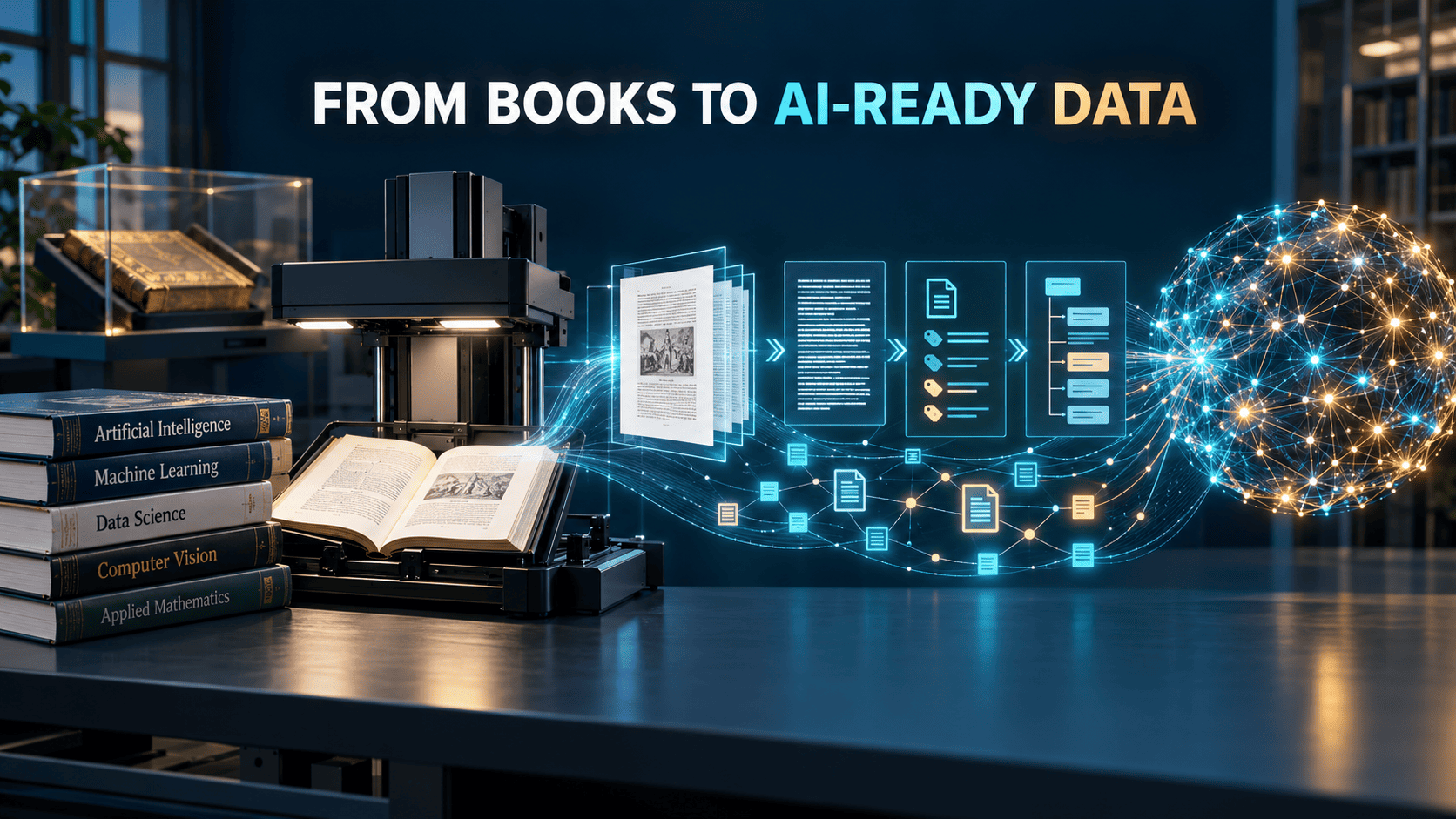
AI Knowledge Infrastructure
Artificial intelligence systems depend on large volumes of organized information. While much of today’s AI training data comes from digital sources, physical books remain an important source of long-form, human-created knowledge.
Books contain:
- Detailed explanations
- Technical information
- Historical records
- Academic research
- Specialized terminology
- Structured discussions developed over hundreds of pages
For AI companies working with large language models (LLMs), document intelligence systems, and retrieval technologies, converting physical books into structured digital information requires more than creating searchable PDFs.
Large-scale projects must preserve relationships between:
- Page images
- Extracted text
- Metadata
- Document structure
- Visual information
Professional book scanning services help organizations transform physical collections into organized digital assets suitable for research, analysis, and AI-related workflows.
Why AI Companies Are Digitizing Physical Books for Training Data
The Value of Human-Created Long-Form Information
AI systems require high-quality information to understand language, concepts, relationships, and specialized topics.
Books provide characteristics that are often difficult to obtain from shorter digital content:
- Extended explanations
- Consistent terminology
- Domain-specific knowledge
- Historical context
- Logical relationships between concepts
A technical manual, scientific publication, legal reference, or academic book may contain interconnected information developed across multiple chapters.
This makes books valuable resources for:
- Large language model development
- Semantic search systems
- Knowledge retrieval platforms
- Document classification
- AI evaluation datasets
The relationship can be summarized as:
Books → provide → structured human knowledge
AI systems → require → organized information sources
How Physical Books Become AI-Ready Data
From Printed Pages to Structured Digital Information
Industrial book digitization usually follows a controlled data pipeline:
| Stage | Purpose |
|---|---|
| Collection assessment | Identify book condition, size, and requirements |
| Preparation | Prepare pages for scanning |
| Image capture | Create high-resolution digital page images |
| OCR processing | Convert images into machine-readable text |
| Metadata creation | Add title, author, edition, and identifier information |
| Quality validation | Confirm accuracy and completeness |
| Digital delivery | Provide files in required formats |
The final output may include:
- TIFF images
- JPEG page images
- OCR text files
- PDF documents
- XML or JSON structured data
- Metadata records
For organizations building searchable archives or AI-ready datasets, OCR data extraction services help convert scanned pages into usable text layers.
Understanding Large-Volume Destructive Book Scanning
Industrial Digitization for High-Volume Collections
Destructive book scanning is a specialized digitization method where the physical binding of a book is removed so individual pages can move through high-speed production scanners.
Unlike traditional overhead scanning, which captures an intact book page by page, destructive scanning prepares books for automated processing.
The process typically includes:
- Reviewing the collection requirements
- Recording book information
- Removing bindings when approved
- Separating pages
- Capturing digital images
- Applying OCR and metadata processing
- Validating completed files
This approach is designed for collections where:
- Speed is important
- Large quantities must be processed
- Original physical copies are not required after digitization
Why AI Companies Use Large-Scale Book Digitization
Expanding Access to Specialized Knowledge
Many valuable books are not available in structured digital formats.
Examples include:
- Academic publications
- Technical manuals
- Industry references
- Historical materials
- Specialized research collections
Digitization allows organizations to transform physical information into searchable and analyzable data.
The semantic relationship:
Physical books → become → machine-readable datasets
OCR technology → enables → searchable text extraction
Metadata → provides → document context
The Growing AI Book Digitization Ecosystem
How Books Move Through the AI Data Pipeline
The modern AI book digitization process involves multiple stages:
Physical Book Collection
 ↓
Collection Assessment
 ↓
Book Preparation
 ↓
Industrial Scanning
 ↓
OCR Processing
 ↓
Metadata Structuring
 ↓
AI-Ready Dataset
Large-scale projects require coordination between:
- Collection owners
- Digitization providers
- Data processing teams
- Quality-control specialists
- AI engineering teams
The scanning process is only one part of the larger data preparation workflow.
AI Companies Are Scanning Books at Industrial Scale: What Reports Highlight
Industry Discussions Around Destructive Scanning
The rapid growth of AI has created increased demand for large volumes of human-created text.
This demand has contributed to discussions about companies acquiring physical books, scanning them, and disposing of the original materials after digitization.
Reports and public discussions have raised questions about:
- The preservation of rare books
- The future of physical collections
- The role of copyright review
- How organizations decide which materials enter destructive workflows
Some commentators have described this trend as:
“AI companies destroying rare books”
However, the actual suitability of destructive scanning depends on:
- The type of collection
- The value of the physical materials
- Ownership rights
- Preservation requirements
- Project goals
A responsible digitization workflow begins with collection evaluation rather than automatic processing.
Project Case Studies and Public Discussion Around AI Book Scanning
Why Large AI Data Projects Created Industry Attention
Large AI-related digitization projects have attracted attention because they demonstrate the scale required to convert millions of physical pages into structured information.
Publicly discussed examples have focused on:
- Large book acquisition programs
- Industrial scanning capacity
- Automated page processing
- Legal questions surrounding digital conversion
The broader lesson for organizations planning similar projects is that successful digitization requires:
- Clear collection policies
- Documented ownership
- Defined output requirements
- Quality-control standards
Machine-Readable Dataset Design
Why Searchable PDFs Are Not Enough for AI Projects
A standard scanned PDF is designed mainly for human reading.
An AI-ready dataset requires deeper organization because machines need to identify, connect, and process different information layers.
A production-grade AI book dataset may include:
| Dataset Layer | What It Contains | Why It Matters |
|---|---|---|
| Image layer | High-resolution page captures | Preserves original visual reference |
| Text layer | OCR-generated text | Enables indexing and search |
| Structure layer | Chapters, headings, tables, captions | Maintains document relationships |
| Metadata layer | Title, author, edition, ISBN, publication details | Provides source context |
| Visual layer | Images, diagrams, illustrations, maps | Supports multimodal analysis |
| Control layer | File manifests, checksums, validation records | Supports quality tracking |
The relationship between these elements is:
Scanned pages → create → source images
OCR processing → generates → machine-readable text
Metadata → connects → digital files with their original source
For projects requiring structured document workflows, document imaging services help organizations create organized digital information systems.
What Files Can Be Included in an AI-Ready Book Dataset?
Flexible Delivery Formats for AI Workflows
The final delivery format depends on how the receiving system will use the information.
Common outputs include:
| Format | Common Use |
|---|---|
| TIFF | Archival-quality page images |
| JPEG/PNG | Visual processing and image analysis |
| Human review and document access | |
| TXT | Extracted text processing |
| XML | Structured document relationships |
| JSON | Machine-readable datasets |
| CSV | Metadata and indexing workflows |
Before production begins, organizations should define:
- Required formats
- Naming conventions
- Metadata fields
- Folder structures
- Quality standards
- Acceptance criteria
This prevents expensive restructuring after digitization.
Destructive vs Non-Destructive Book Scanning: Choosing the Right Method
Collection Requirements Determine the Best Approach
Not every book collection should enter a destructive workflow.
The correct method depends on:
- Physical value
- Condition
- Preservation goals
- Intended use
- Required processing speed
| Factor | Destructive Scanning | Non-Destructive Scanning |
|---|---|---|
| Binding removal | Required | Not required |
| Processing speed | Faster for large volumes | Slower |
| Automation | High | Limited |
| Physical preservation | Original binding removed | Original retained |
| Suitable materials | Replaceable collections | Rare or fragile books |
| Cost efficiency | Better for bulk projects | Better for preservation |
Organizations working with valuable historical collections may require specialized fragile book scanning approaches to protect original materials.
When Should Companies Avoid Destructive Book Scanning?
Collection Risk Assessment
Destructive scanning is not appropriate for every book.
Materials requiring additional review may include:
- Rare editions
- Signed copies
- Fragile historical books
- Books with damaged bindings
- Annotated personal collections
- Volumes containing inserts or unique physical features
A preservation-focused assessment should determine whether the physical object itself has value beyond the information contained inside.
The relationship:
Rare books → require → preservation evaluation
Fragile materials → need → specialized handling
Quality Control Standards for Large-Scale Book Digitization
Enterprise Processing Standards
Processing thousands or millions of pages requires measurable quality controls.
A strong quality-control program evaluates:
| Quality Area | Validation Checks |
|---|---|
| Image quality | Blur, cropping, orientation, readability |
| Page sequence | Missing or duplicated pages |
| OCR accuracy | Text extraction quality |
| Metadata | Correct identifiers and descriptions |
| File integrity | Naming, completeness, delivery validation |
Quality assurance should begin before production through:
- Pilot batches
- Approved specifications
- Sampling procedures
- Error tracking
- Correction workflows
This approach ensures that digital files remain consistent across large collections.
Copyright and Legal Considerations Before Digitizing Books
Rights Review and Documentation
Book digitization projects require careful consideration of ownership and usage rights.
Owning a physical book does not automatically mean owning every right associated with the content.
Organizations should review:
- How books were acquired
- Whether copyright protection applies
- Intended use of digital files
- Who can access the dataset
- Whether files may be shared externally
A documented rights process helps define project boundaries before scanning begins.
Physical Ownership vs Copyright Ownership
Understanding the Difference
A physical copy of a book and the intellectual property inside that book are separate concepts.
A project may need to evaluate:
| Question | Why It Matters |
|---|---|
| Who owns the physical copy? | Establishes possession |
| Who owns copyright? | Determines content rights |
| How will digital files be used? | Defines project purpose |
| Who can access outputs? | Controls distribution |
Legal review should be handled by qualified professionals familiar with the applicable jurisdiction and project requirements.
What Happens to Books After Destructive Scanning?
Physical Material Disposition Planning
After scanning, organizations should establish clear instructions for handling separated pages and bindings.
Possible outcomes may include:
- Recycling
- Secure disposal
- Temporary retention
- Return of materials
A documented disposition process should identify:
- Processed collection
- Completion date
- Approved handling method
- Responsible parties
For organizations managing sensitive records, document shredding services may support secure destruction requirements when applicable.
How AI Companies Should Evaluate a Large-Volume Book Scanning Partner
Enterprise Processing Capability
Selecting a scanning provider requires evaluating more than scanner speed.
Important factors include:
Production Capacity
A qualified provider should demonstrate:
- Ability to manage large collections
- Consistent processing workflows
- Trained production teams
- Equipment availability
Dataset Quality Management
Ask how the provider handles:
- OCR validation
- Metadata accuracy
- File organization
- Batch approval
Security and Chain of Custody
Large collections require controlled handling from intake through delivery.
Important considerations:
- Inventory tracking
- Secure transportation
- Access controls
- Delivery verification
- Processing documentation
Organizations planning enterprise-scale conversion projects can explore large-scale book digitization services for customized workflows.
Preparing Your Book Collection for AI Digitization
Project Planning Guidance
Before production begins, organizations should define:
Collection Details
Provide:
- Number of books
- Average page count
- Book sizes
- Languages
- Condition requirements
Technical Requirements
Define:
- Resolution
- Color settings
- OCR expectations
- Metadata fields
- Delivery formats
Operational Requirements
Clarify:
- Shipping arrangements
- Approval process
- Quality standards
- Final disposition instructions
A clear project specification reduces delays and improves consistency.
Are You Ready to Convert Your Book Collection Into AI-Ready Data?
Customized Digitization Planning
Successful AI digitization projects require more than scanning pages.
They require a complete workflow connecting:
- Physical collections
- Digital capture
- OCR processing
- Metadata organization
- Quality validation
- Final delivery
eRecordsUSA provides large-volume destructive book scanning solutions for organizations that need structured, production-ready digital datasets.
We help define workflows based on:
- Collection size
- Required outputs
- Processing specifications
- Quality expectations
Ready to discuss your book digitization project?
Contact eRecordsUSA to review your collection requirements and request a customized scanning plan.
Request a Quote:
https://www.erecordsusa.com/request-a-quote/
Frequently Asked Questions About Large-Volume Destructive Book Scanning
What is destructive book scanning for AI companies?
Destructive book scanning is a digitization method where a book’s binding is removed so individual pages can be processed through high-speed scanners. The captured images can then be converted into searchable text, metadata, and structured digital datasets.
Why are AI companies interested in scanning physical books?
AI companies use digitized books because they contain long-form human-created information, specialized terminology, and structured knowledge that can support research, retrieval systems, and AI development workflows.
Are rare books suitable for destructive scanning?
Rare, fragile, or historically significant books usually require evaluation before destructive processing. Non-destructive scanning may be more appropriate when preserving the physical item is important.
What information can an AI-ready book dataset contain?
An AI-ready dataset may include:
- Page images
- OCR text
- Metadata
- Structural information
- Visual elements
- Validation records
How long does a large-volume book scanning project take?
Project timelines depend on:
- Collection size
- Page complexity
- Required outputs
- Quality requirements
- Approval processes
A pilot batch is often used to establish realistic production expectations.
Can multilingual books be converted into searchable text?
Yes. Multilingual digitization projects can use OCR technologies designed for supported languages and scripts. Requirements should be defined before production begins.