
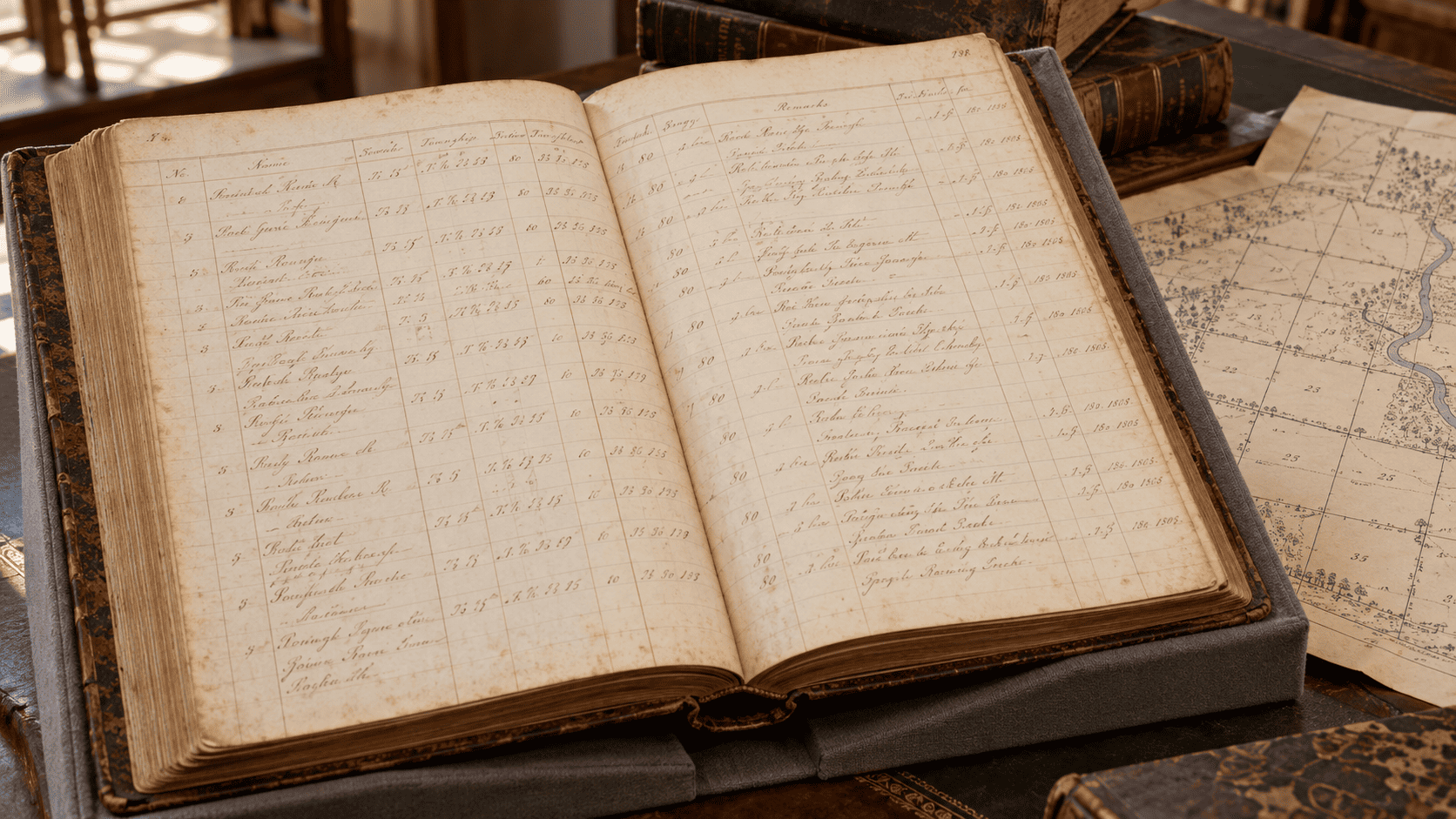
Trying to trace an ancestor’s land ownership but struggling to find the original land claim?
Historical property records can be difficult to navigate, especially when names, dates, and land descriptions appear across multiple government archives.
According to a September 2026 report from the Bureau of Land Management (BLM), its General Land Office collection contains more than 12 million historical land title records, including patents, survey plats, field notes, and tract books, with some dating back to 1787 (Source).
Among these records, tract books help researchers connect specific land parcels with historical federal land transactions, uncovering details that might otherwise remain difficult to trace.
What are Tract Books and Why Were They Created?
Tract books are historical government registers that document land entries and transactions involving federal public lands in the United States. As the country expanded westward, the federal government needed a systematic way to track the distribution and sale of these lands. TheGeneral Land Office (GLO), established in 1812, used tract books to organize land entries geographically and maintain records of federal land transactions.
These registers helped land officials document several types of transactions:
- Public land purchases: Recording parcels sold to individuals and other buyers.
- Homestead claims: Recording entries made under federal homestead laws; the underlying application and final-proof files are generally held by the National Archives.
- Military bounty land warrants: Recording land entries made using warrants awarded for military service.
- Land entry status: Documenting transactions and cancellations where noted.
Tract books also served as geographical indexes to land entry case files, connecting surveyed parcels with supporting government records.
Federal tract books primarily document public-land transactions from 1820 through the mid-20th century, although coverage and surviving volumes vary by state and land office. Today, these registers provide historical evidence of how federal public lands were claimed, transferred, and administered.
What Information Is Recorded in Tract Books and How Do You Read it?
Tract books organize historical land records geographically, making the legal description of a land parcel essential for locating and interpreting individual entries. Unlike alphabetical name indexes, these registers typically group information by township and range, allowing researchers to examine records associated with a particular location.
Common Details Found in Tract Book Entries
Although layouts differ by period and land office, researchers may encounter the following information:
- Names of applicants: Individuals associated with a recorded land entry.
- Acreage and parcel descriptions: The size and surveyed location of the land.
- Dates of record: Dates associated with applications, entries, or subsequent administrative actions.
- Certificate and patent references: Numbers or annotations that may help identify related government documents.
These fields provide identifying information that researchers can use to distinguish between individuals with similar names or locate corresponding archival records.
How to Interpret Township, Range, and Section Numbers
The Public Land Survey System (PLSS) identifies land through a standardized geographic framework. A typical surveyed township contains 36 sections, each measuring approximately 640 acres, although actual dimensions can vary.
A legal land description generally includes:
- Township (T): Position north or south of a baseline.
- Range (R): Position east or west of a principal meridian.
- Section: A numbered division within a township.
- Fractional description: A smaller portion of a section, such as a quarter-section.
For example: T2N, R3E, Section 9, SE¼
This describes the southeast quarter of Section 9 in Township 2 North, Range 3 East. In a standard section, the quarter represents approximately 160 acres.
The state and applicable principal meridian are also required to identify the parcel precisely. Researchers can match these geographic identifiers with historical survey plats to determine where the recorded parcel was located.
Tract Books vs. Plat Books, Land Patents, and Deeds: Key Differences
Historical land records serve different legal, geographic, and administrative purposes. Choosing the appropriate record depends on whether a researcher needs to identify a parcel, examine a government grant, or investigate subsequent ownership transfers.
| Record Type | Primary Purpose | What It Shows |
| Tract Books | Index federal land entries geographically | Land entry references associated with surveyed parcels |
| Plat Books | Show surveyed land layouts | Parcel boundaries, sections, and geographic features |
| Land Patents | Document the government’s transfer of land title | Original grantees, legal descriptions, and grant details |
| Property Deeds | Record property conveyances | Grantors, grantees, and property transfer details |
These records complement one another, but a single document does not necessarily establish a property’s complete chain of title.
Where to Find Tract Books Online and How to Use Them for Genealogy
Searching historical tract books requires more than entering an ancestor’s name into a database. Because these registers are organized geographically, identifying the relevant state, land office, township, and range makes it easier to locate the correct records.
Where to Search Historical Tract Books Online
Several authoritative repositories provide access to historical land records:
- Bureau of Land Management (BLM): Search federal land patents and survey records to identify geographic information useful for tract book research.
- FamilySearch: Browse digitized tract book collections using available geographic and collection-level identifiers.
- National Archives (NARA): Consult archival finding aids and federal land entry case files to investigate transactions identified in historical registers.
Tracing Ancestors, Homestead Claims, and Land Entry Case Files
Once researchers identify a relevant entry, the next step is to examine what additional records it can lead to.
Depending on the type of land transaction, supporting case files may reveal:
- Residency evidence: Documents describing where an applicant lived or fulfilled settlement requirements.
- Family relationships: Names or statements involving spouses, heirs, or witnesses.
- Citizenship information: Naturalization details or declarations where required by the applicable land law.
- Claim outcomes: Evidence explaining why an application was completed, relinquished, or canceled.
These details are not guaranteed to appear in every case file. Their availability depends on the land law, transaction type, and surviving documentation.
Researchers can use these supporting documents to establish a more detailed account of an ancestor’s circumstances than a tract book entry alone provides.
How Are Fragile Tract Books Scanned and Digitized Without Damage?
Historical tract books may suffer from brittle paper, weakened bindings, faded ink, and damage caused by decades of storage or handling. Digitizing these bound records requires a preservation-focused approach that considers their physical condition before image capture begins.
Non-Destructive Scanning of Fragile Bound Records
Non-destructive scanning can digitize suitable historical volumes without removing their bindings. The scanning method depends on the book’s condition, opening limitations, and page accessibility.
Key considerations include:
- Book cradle support: Stabilizes bound volumes without forcing their spines or pages flat.
- Overhead or planetary scanners: Capture pages from above while accommodating appropriate opening angles.
- Controlled lighting and focus: Improve image clarity without applying unnecessary pressure to fragile materials.
- Inner-margin visibility: Requires careful positioning because text near the binding may be difficult to capture completely.
TheLibrary of Congress emphasizes careful assessment and handling when digitizing fragile collection materials.
Making Handwritten Land Records Digitally Accessible
Creating digital images is only the first step toward making historical registers easier to use.
Archives can improve digital access through several methods:
- Archival image files: Retain detailed visual reproductions of original pages.
- Structured metadata: Connect scanned images with searchable catalog information.
- Handwritten Text Recognition (HTR): Uses recognition technology to convert handwriting into machine-readable text.
- Manual quality checks: Help identify transcription errors, missing pages, or incomplete image capture.
HTR accuracy varies with handwriting styles, image quality, and document condition. Human review may therefore be necessary before researchers can reliably use the extracted text.
Conclusion
Tract books provide valuable evidence of America’s historical land transactions, helping genealogists, historians, and researchers investigate early land claims and trace property histories. Understanding these records makes historical research more effective, while careful digitization helps preserve their contents for future generations.
For libraries, archives, and historical societies managing fragile collections,eRecordsUSA offers professional book scanning and digitization services to help preserve historical records while improving digital access.
FAQs About Tract Books
Are tract books available for every U.S. state?
No. Federal tract books primarily cover public-land states where the U.S. government administered land distribution. State-land states, including the original 13 states and several later states such as Kentucky, Tennessee, Texas, and Hawaii, maintained their own land-record systems rather than the federal public-land system.
Can tract books reveal canceled land claims?
Yes. Some tract books contain annotations identifying canceled or relinquished land entries. These records can help researchers investigate claims that never resulted in a land patent.
Do tract books prove legal ownership of land?
Not necessarily. Tract books document federal land entries, but a recorded claim does not always establish ownership. Land patents and subsequent deeds provide additional evidence of title.


