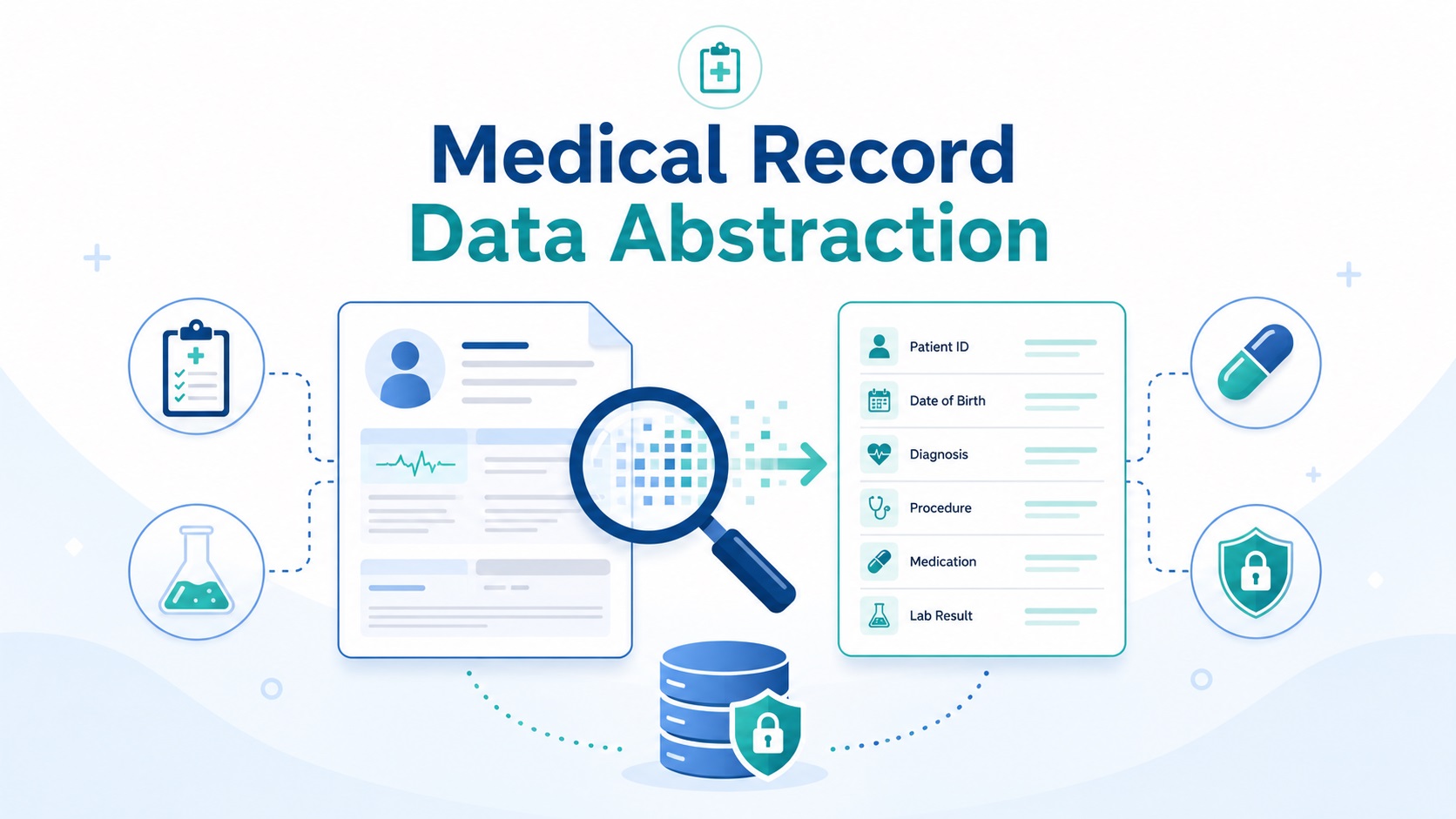
If you’re wondering how to become a medical records abstractor, what examples of data abstraction are, and what the 5 C’s of medical record documentation are, it helps to first understand the core function of the role.
Medical record data abstraction plays a foundational role in healthcare operations by ensuring that only relevant, structured information is captured from patient records for use in reporting, research, and electronic health systems.
This function is especially important as healthcare organizations continue to expand digital adoption.
According to the Office of the National Coordinator for Health Information Technology, more than 99% of non-federal acute care hospitals in the United States have adopted certified EHR systems as of 2024. (Source)
With such widespread digitization, the need for accurate data abstraction has grown significantly to ensure data consistency, support ICD-10 coding accuracy, enable HIPAA-compliant reporting, and improve clinical decision-making.
Common examples of data abstraction include:
- Pulling active diagnoses from progress notes
- Recording current medications from discharge summaries
- Extracting laboratory values from test reports
- Documenting surgical procedures or outcomes for registries, progress notes, queries, and audits
Medical record data abstraction depends on complete, legible, and well-organized source documents.eRecordsUSA’s medical records scanning services help healthcare organizations prepare, scan, index, and convert paper patient charts into searchable, EHR-compatible digital files. This gives authorized healthcare teams a more accessible source-record foundation for abstraction, EHR migration, review, and other records-management tasks without treating scanning and clinical abstraction as the same service.
Medical records abstractors commonly develop knowledge of medical terminology, health information management, nursing, coding, or clinical research, along with strong attention to detail and EHR proficiency. Reliable abstraction also depends on source documentation that is clear, concise, complete, correct, and consistent.
The 5 C’s of Medical Record Documentation
Source documentation that supports reliable abstraction should follow five core principles, commonly known as the 5 C’s:
- Clear: information is legible and unambiguous
- Concise: only relevant details are included, without unnecessary duplication
- Complete: all required fields and clinical facts are present
- Correct: data is accurate and free from error
- Consistent: terminology, formatting, and dates are uniform across the record
When these principles are followed, reviewers can identify the required information with less ambiguity.
By transforming selected information from paper charts, scanned files, and electronic documentation into structured data, medical record abstraction makes important patient information easier to retrieve and use.
This guide explains what information may be abstracted, how the process works, how abstraction differs from scanning and coding, and how healthcare organizations maintain accuracy, privacy, and security.
What Does It Mean to Abstract a Medical Record?
To abstract a medical record means to locate specific facts within the record and record those facts in a consistent format.
According to anNIH-published clinical data abstraction study, clinical data abstraction captures key administrative and clinical data elements from a medical record.
The process has four basic components:
- A source record contains the original information.
- An abstraction plan defines what information is needed.
- An abstractor applies the plan to select and validate relevant facts.
- The approved data is entered into an EHR, registry, database, or other destination.
For example, consider a 100-page paper chart created over several years. An EHR migration project may require the patient’s active diagnoses, known allergies, current medications, prior surgeries, and most recent test results.
The abstractor reviews the chart and enters only those approved elements into corresponding EHR fields. Duplicate pages, expired prescriptions, and information outside the project scope remain in the source record but are not added to the structured dataset.
Abstraction is therefore selective. It does not mean transferring every word from every page.
What Information Is Abstracted From Medical Records?
The information collected depends on the purpose of the project. Before work begins, the healthcare organization should establish a data dictionary or abstraction protocol defining the required fields, accepted sources, date ranges, and decision rules.
Patient, Encounter, and Medical History Data
Administrative and historical fields may include:
- Patient name and medical record number
- Date of birth and demographic information
- Encounter dates and locations
- Treating provider
- Active and historical diagnoses
- Past medical and surgical history
- Procedures and treatment dates
- Relevant family or social history
These fields help identify the patient, place events in chronological order, and preserve significant parts of the medical history.
Medications, Allergies, Immunizations, and Clinical Results
An abstraction project may also capture:
- Current medications and dosages
- Medication start or stop dates
- Documented drug and environmental allergies
- Adverse reactions
- Immunization history
- Laboratory values
- Imaging findings
- Vital signs
- Pathology results
- Discharge instructions
Not every project requires every category. A research study may request narrowly defined outcomes, while a practice conversion may prioritize information clinicians need when the new EHR goes live.
How Does the Medical Record Data Abstraction Process Work?
A reliable medical record data abstraction project follows documented rules from planning through final review. The exact tools may vary, but the underlying workflow remains consistent.
1. Define the Purpose and Required Data Elements
The organization first determines why the data is being collected. Common purposes include EHR migration, clinical research, registry reporting, quality measurement, audit preparation, or historical-record consolidation.
The project team then specifies:
- Records and date ranges to include
- Required data fields
- Acceptable source documents
- Inclusion and exclusion criteria
- Formatting requirements
- Rules for missing or conflicting information
- The destination for approved data
These instructions prevent individual reviewers from deciding independently what appears important.
2. Prepare and Digitize Source Records
When information exists on paper, the charts must be organized and scanned before electronic abstraction can begin.
Preparation may involve removing fasteners, repairing damaged pages, arranging documents, identifying patient files, and separating pages that should not be included.
After scanning, the images should be checked for:
- Missing or repeated pages
- Cropped content
- Incorrect orientation
- Unreadable text
- Pages assigned to the wrong patient
- Incomplete document groups
Optical character recognition, or OCR, may make typed text searchable. However, OCR output is not itself an abstracted medical record. It recognizes characters; it does not determine whether a clinical fact meets the project’s selection rules.
3. Review, Extract, Validate, and Enter the Data
The abstractor examines approved sources such as progress notes, history and physical reports, discharge summaries, medication lists, laboratory reports, imaging reports, and operative notes.
When a required fact is found, the reviewer checks its context before recording it. A diagnosis mentioned as a possibility, for instance, should not automatically be treated as a confirmed active diagnosis. Likewise, a medication appearing in an old note may not represent the current medication list.
The selected facts are entered into structured EHR fields, electronic forms, registries, spreadsheets, or databases. Required formats may include dates, numerical values, coded options, or short text entries.
If two sources disagree, the reviewer follows the approved source hierarchy or flags the record for resolution. Guessing should never replace a documented exception procedure.
4. Perform Quality Assurance and Resolve Exceptions
Quality assurance begins after the first-pass abstraction. Depending on project risk and scale, it may include:
- Required-field checks
- Logic and date validation
- Duplicate detection
- Comparison with source documents
- Secondary review of selected records
- Review of unusual or high-risk findings
- Correction logs and audit trails
- Escalation of unresolved discrepancies
For projects using multiple reviewers, agreement can be evaluated through inter-rater reliability – the extent to which different abstractors reach the same result when applying the same rules.
Medical Record Abstraction vs. Related Processes
Medical record abstraction is often confused with scanning, OCR, data entry, medical coding, and chart review. Each process produces a different result.
| Activity | Primary purpose | Input | Output | Human judgment |
| Scanning | Create a digital copy | Paper pages | Document images | Limited |
| OCR | Recognize printed or handwritten characters | Document images | Machine-readable text | Usually needed for correction |
| Data entry | Transfer specified information | Source documents or forms | Entered values | Varies |
| Data abstraction | Select and validate defined facts | Complete patient records | Structured clinical or administrative data | Significant |
| Medical coding | Assign standardized codes | Clinical documentation | Diagnosis or procedure codes | Significant |
| General chart review | Understand the broader clinical record | Patient chart | Narrative interpretation or findings | Significant |
Medical Record Abstraction vs. Scanning, OCR, and Data Entry
Scanning preserves the page as an image. OCR converts visible characters into searchable text. Data entry transfers information into another system.
Whereas abstraction adds a rule-based selection step. The abstractor must determine which documented facts qualify, which source controls when entries conflict, and where the approved information belongs.
These services may occur in one project, but they are not interchangeable. A practice can scan every chart and still leave important information buried inside hundreds of document images.
Medical Record Abstraction vs. Medical Coding
Medical coding translates documented diagnoses, services, and procedures into standardized code sets used for functions such as billing and reporting.
However, abstraction collects the underlying facts required by a particular project. It might record the date of a procedure, a laboratory value, medication status, or clinical outcome without assigning a billing code.
One process can support the other, but abstraction should not be described as coding.
Medical Record Abstraction vs. General Chart Review
A general chart review may be exploratory. A clinician, auditor, attorney, or researcher reads the record to understand a case, answer a broad question, or reconstruct a sequence of events.
Formal abstraction is more constrained. Reviewers follow predefined criteria and return discrete data elements in a standardized format. The difference lies in the output: chart review develops an understanding of the record, while abstraction creates a defined dataset.
Manual and Automated Medical Record Abstraction
The appropriate method depends on record quality, data complexity, project volume, acceptable error risk, and available technology.
Manual and Technology-Assisted Medical Record Abstraction
In manual medical record abstraction, trained reviewers locate and enter the required information themselves. This approach can be appropriate when records contain handwriting, inconsistent formats, ambiguous statements, or information requiring contextual interpretation.
Technology-assisted medical record abstraction remains human-led. Search tools, OCR, natural language processing, or AI may highlight candidate passages and reduce the amount of text a reviewer must inspect. The reviewer then confirms whether each suggestion meets the abstraction rules.
This hybrid model can improve workflow efficiency without transferring final responsibility to the software.
Automated Medical Record Abstraction and Human Validation
Automated systems attempt to identify and structure data with limited case-by-case input. They are best suited to well-defined fields, repeatable document types, and sufficiently consistent source material.
Automation must still be tested against representative records. Accuracy may change when templates, handwriting, terminology, patient populations, or documentation practices change. Exception handling is especially important when the software encounters missing values, contradictory statements, or low-confidence results.
On the other hand, human validation should be concentrated where errors could affect care, reporting, research conclusions, or other high-impact decisions. Automation can accelerate identification; it does not guarantee that a candidate value is clinically correct.
Why is Medical Record Data Abstraction Important?
The value of abstraction comes from making selected information easier to retrieve, compare, and use. Its practical benefit depends on whether the project collects the right elements accurately.
Better Access to Historical Patient Information During EHR Migration
Moving from paper charts or a legacy system to a new EHR creates a choice: retain older records only as scanned documents or place essential facts into searchable fields.
Abstraction allows selected historical information to appear where authorized users expect to find it. Instead of opening numerous files to locate an allergy or prior procedure, a clinician may be able to review the approved information in the appropriate part of the EHR.
This supports access to relevant history while allowing the full source chart to remain available when greater detail is needed.
More Reliable Coding, Reporting, and Audits
Structured facts can support downstream activities that depend on consistent source information. These may include coding review, compliance checks, registry submissions, quality measurement, and audit preparation.
Abstraction does not guarantee that every later process will be accurate. It creates a traceable and standardized starting point. When validation rules and source references are preserved, reviewers can investigate how a value was selected.
Structured Data for Research and Quality Improvement
Clinical records contain valuable information in both structured fields and free-text documents. Research teams may use abstraction to collect specific variables that are not consistently available in standard reports.
The resulting dataset can support outcome analysis, cohort identification, quality studies, and comparisons across records.
AnNIH study of unstructured data in multisite medical-record abstraction demonstrates why consistent definitions and handling rules matter when information comes from different record systems.
The research question should determine what is collected. Collecting extra variables without a defined purpose increases workload and may introduce avoidable inconsistency.
Common Medical Record Abstraction Challenges
Abstraction becomes more difficult when the source is hard to read, the documentation disagrees, or project capacity does not match record volume.
Poor Image Quality and Handwritten Information
Faint carbon copies, folded pages, stains, cropped scans, unusual handwriting, and low-resolution images can prevent reviewers from reading the source confidently.
Rescanning may solve an image-quality problem but cannot restore information that was illegible in the original record. When the content remains uncertain, the abstractor should mark it according to the project’s missing-data or exception rules rather than infer a value.
Incomplete, Conflicting, and Inconsistently Formatted Records
A patient’s information may appear under different abbreviations, document titles, date formats, or provider templates. The same fact may also be copied forward after it is no longer current.
These issues require:
- A defined order of source authority
- Standard terminology rules
- Duplicate-management procedures
- Valid options for unknown or unavailable data
- Escalation paths for unresolved conflicts
The protocol should explain how to handle uncertainty before reviewers encounter it at scale.
High Record Volumes and Limited Internal Resources
Large conversions can place significant demands on employees who are already responsible for active patient care, billing, compliance, or records management.
Rushing increases the risk of reviewer fatigue, inconsistent decisions, and incomplete quality checks. A realistic plan should consider chart volume, page count, source condition, field complexity, reviewer availability, training time, and the proportion of records requiring secondary review.
How Are Accuracy, Privacy, and Security Maintained in Medical Record Abstraction?
Accuracy and security require separate controls. Quality procedures protect the reliability of the data, while privacy and security safeguards protect the patient information being handled.
Standardized Rules, Reviewer Training, and Quality Control
A strong quality program begins with written instructions. Reviewers should receive training on the data dictionary, qualifying documentation, source priority, prohibited assumptions, and exception procedures.
A pilot sample can reveal unclear rules before full production begins. The team can then revise instructions, provide examples, and calibrate reviewers against an approved answer set.
Ongoing monitoring may use random sampling, targeted review of high-risk fields, automated validity checks, and error-rate tracking. When a pattern appears, the response should address its cause—for example, ambiguous instructions or a new document format—not merely correct individual records.
Privacy and Security Safeguards for Protected Health Information
Medical records may contain protected health information, or PHI. Organizations subject to HIPAA must determine which Privacy, Security, and Breach Notification Rule requirements apply to their work and relationships.
TheHHS summary of the HIPAA Security Rule explains that regulated entities must apply administrative, physical, and technical safeguards to electronic protected health information.
Depending on the environment and risk analysis, relevant measures may include:
- Access based on job responsibilities
- Unique user authentication
- Secure file-transfer methods
- Encryption where appropriate
- Audit logging
- Workstation and device controls
- Workforce training
- Documented incident procedures
- Secure retention and disposal processes
If an outside provider creates, receives, maintains, or transmits PHI on behalf of a covered entity, the parties should determine whether a business associate relationship exists and execute the required agreement when applicable.
When Should a Healthcare Organization Consider Outsourcing Abstraction?
External support may be useful when a healthcare organization has a large backlog, a fixed EHR migration deadline, limited abstraction expertise, fluctuating demand, or quality-control requirements that exceed internal capacity.
Before selecting a provider, ask:
- What experience do reviewers have with medical terminology and the relevant record types?
- How will the provider apply the organization’s abstraction rules?
- Which fields will receive secondary review?
- How are errors measured, corrected, and reported?
- What happens when records are incomplete or contradictory?
- How will PHI be transferred, accessed, retained, and disposed of?
- Will subcontractors handle any part of the project?
- How will completed data be delivered or imported?
- Can the provider conduct a pilot before full production?
- How will progress and unresolved exceptions be reported?
A useful proposal should define scope, responsibilities, quality thresholds, security expectations, and delivery requirements rather than promising a universal turnaround time.
eRecordsUSA helps organizations prepare, scan, index, and convert medical records for secure digital use.
Call us at 1.510.900.8800, or write us at he***@*********sa.com to discuss your source records, required data fields, destination system, and quality-control needs.
Frequently Asked Questions About Medical Record Data Abstraction
Q1. How long does a medical record data abstraction project take?
Answer: Project duration depends on record volume, page count, source quality, required fields, reviewer capacity, and quality checks. A representative pilot helps the organization estimate the full timeline.
Q2. How much does medical record data abstraction cost?
Answer: Medical record data abstraction costs vary by chart volume, record complexity, required data fields, source format, turnaround time, and QA level. Providers typically prepare estimates after reviewing a sample.
Q3. Which medical records should be prioritized for abstraction?
Answer: Healthcare organizations commonly prioritize active-patient charts, allergies, medications, current diagnoses, recent test results, and records needed for upcoming care. Project goals determine the final priority order.
Q4. What software is used for medical record data abstraction?
Answer: Abstractors may use EHR platforms, registry tools, secure databases, OCR software, NLP systems, or specialized abstraction applications. The source records and required data output determine the appropriate software.
Q5. What should a completed medical record abstraction project deliver?
Answer: A completed project should deliver validated structured data, documented exceptions, quality-control results, and an audit trail. The organization should receive the data in a format compatible with its EHR, registry, or database.