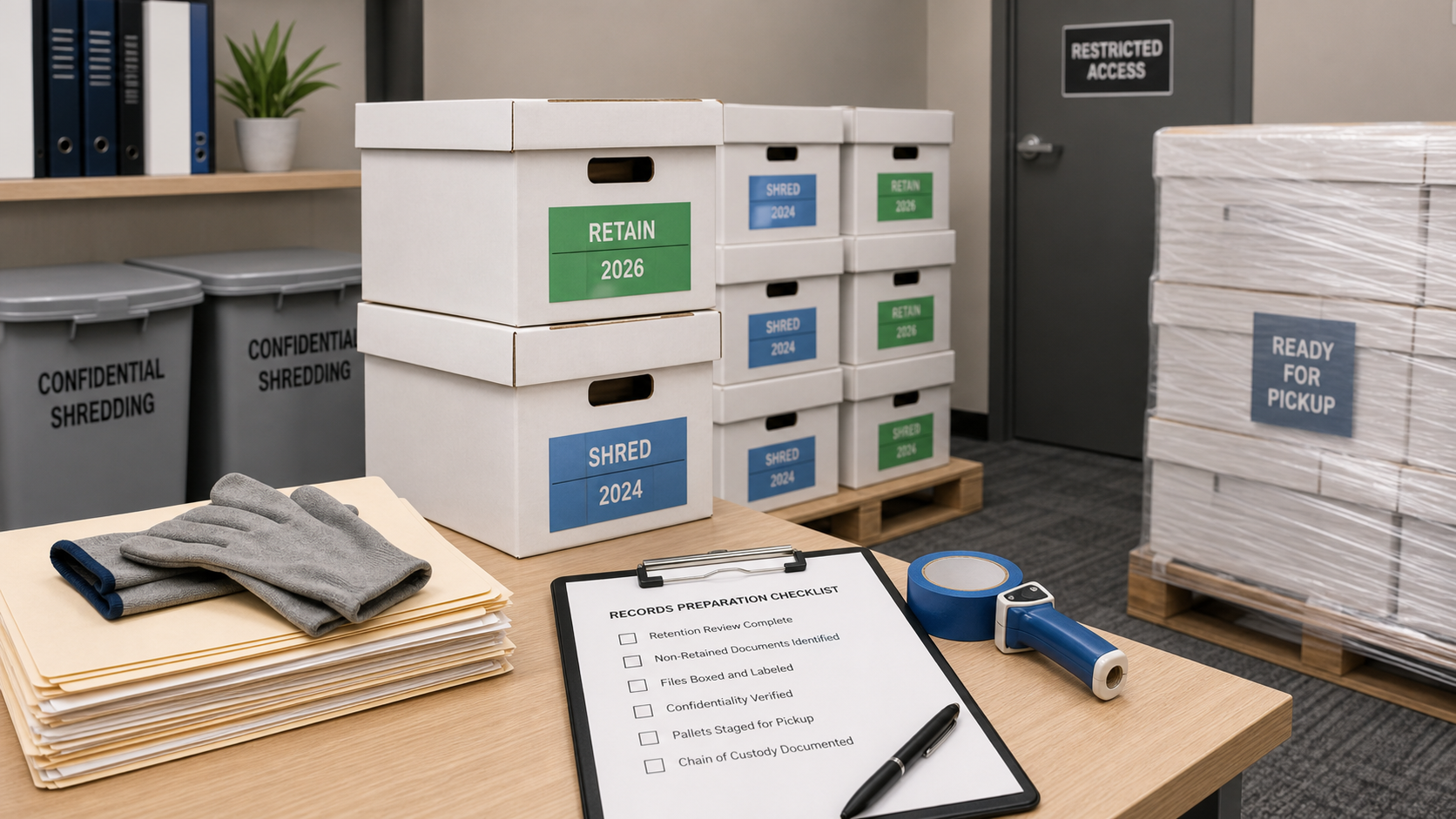
Office relocation shredding helps businesses review, separate, and securely destroy eligible paper records before they move into a new location. For HR and financial files, the process should begin with retention review, department approval, controlled staging, chain-of-custody documentation, and a Certificate of Destruction.
The risk is not just the number of boxes. A move can expose payroll records, employee files, tax documents, invoices, audit files, contracts, banking records, and duplicate archives that have been sitting in cabinets or storage rooms for years. Some records still need to be retained. Others may be expired, duplicated, or safe to destroy. Treating all records the same can create avoidable privacy, compliance, and audit risk.
Government records-management guidance says office moves create logistical challenges around access, security, and record integrity, but they also create an opportunity to reduce the volume of records being moved. The same guidance warns that waiting until after the move can lead to misplaced records, security breaches, and accidental destruction of official records.
Retention rules also vary by record type. The U.S. Department of Labor says employers must preserve payroll records for at least three years, while wage-computation records such as time cards and wage tables should be retained for two years. The EEOC says personnel or employment records are generally kept for one year, and payroll records under ADEA and FLSA-related requirements are kept for three years. The IRS says employment tax records should be kept for at least four years after filing the fourth quarter for the year.
That is why a 20-pallet cleanup should not be handled as a last-minute moving task. IBM’s 2025 Cost of a Data Breach Report puts the global average cost of a data breach at $4.4 million, which makes uncontrolled handling of sensitive paper records a real business concern during relocation. For records containing consumer report information, the FTC Disposal Rule also requires reasonable disposal measures that protect against unauthorized access or use.

Why Office Moves Create a Records-Disposal Risk
An office move creates a records-disposal risk because old paper files are removed from normal storage controls at the same time movers, contractors, IT vendors, cleaners, and building staff may be active on-site. Confidential records that were previously locked in cabinets can become exposed during packing, staging, loading, and transport.
The safest relocation plan separates records into three groups: records to move, records to store, and records approved for secure destruction. This prevents expired paper files from being carried into the new office simply because nobody had time to review them.
For large offices, relocation can uncover:
- Employee files, payroll forms, benefits records, and termination documents
- Tax records, invoices, audit binders, payment files, and bank statements
- Vendor contracts, customer files, internal reports, and legal correspondence
- Duplicate copies, convenience printouts, outdated binders, and unknown boxes
The goal is not to shred everything. The goal is to identify which records have met retention requirements, confirm they are not on hold, and destroy them through a documented process before they create risk in the new location.
What Retention Rules Should You Check Before Shredding?
Before shredding HR or financial records, businesses should check federal retention rules, state-specific requirements, internal policies, audit needs, and any litigation or investigation holds. A relocation deadline should never replace a records-retention review.
Key retention checks include:
| Record category | Common requirement to verify | Why it matters before shredding |
|---|---|---|
| Payroll records | DOL and EEOC guidance commonly point to at least 3 years | Payroll records may be needed for wage, hour, and employment-law review. |
| Wage computation records | DOL guidance commonly points to 2 years | Time cards, wage tables, and schedules can support how pay was calculated. |
| Personnel records | EEOC guidance generally requires 1 year for covered employers | Employee files may relate to employment decisions or claims. |
| Employment tax records | IRS guidance says at least 4 years after filing Q4 for the year | Tax records must remain available for IRS review. |
| Consumer report information | FTC Disposal Rule requires reasonable disposal measures | Background checks and similar records may require secure destruction controls. |
State rules, contract terms, insurance requirements, grant requirements, and industry rules may require longer retention. If a file is connected to an audit, employee dispute, investigation, tax matter, lawsuit, or pending request, it should be placed on hold rather than included in the shredding pallet.
Which HR and Financial Records Need Controlled Destruction?
HR and financial records need controlled destruction when they contain personal, payroll, tax, account, vendor, payment, or business-sensitive information. These files should not be mixed with ordinary office cleanup material during relocation.
High-risk HR records often include employee files, payroll forms, benefits documents, onboarding records, background-check material, disciplinary records, termination files, and medical or leave-related documents. Financial records may include invoices, bank statements, tax files, audit documents, expense reports, payment records, vendor contracts, and accounting files.
These files may contain Social Security numbers, addresses, salary details, tax identifiers, banking information, insurance details, signatures, vendor pricing, or client billing information. During a move, these documents should remain in a restricted workflow from review to pickup.
Controlled destruction protects the document lifecycle after retention has been satisfied. It does not replace the retention decision itself.
How to Classify Records Before a Bulk Shredding Pickup
Records should be classified before pickup so approved destruction files do not get mixed with active, unknown, or hold-status documents. Classification gives HR, finance, legal, compliance, and operations teams a clear decision path.
Use four working categories:
- Expired: records past the required retention period and approved for destruction.
- Active: records still needed for business, HR, finance, legal, or operational use.
- On hold: records connected to audits, litigation, investigations, employee matters, tax reviews, contracts, or pending requests.
- Unknown: records with unclear ownership, missing dates, or incomplete retention status.
Unknown records should not be shredded during move pressure. Assign them to a department owner, confirm date ranges, and document the final decision. For a 20-pallet project, this step prevents accidental destruction and gives the business a defensible internal record.

How to Prepare 20 Pallets for Secure Document Shredding
A 20-pallet shredding project needs staging discipline, clear labels, and basic internal tracking before the shredding provider arrives. The larger the volume, the easier it is for unapproved boxes to be moved accidentally.
Prepare the pallets by:
- Labeling each pallet by department, record group, approval status, and pickup location.
- Separating active, unknown, and hold-status files from destruction-ready pallets.
- Restricting the staging area to approved staff and authorized shredding personnel.
- Confirming loading dock access, elevator use, parking clearance, building security rules, and pickup timing.
- Keeping an internal log with pallet count, department owner, record type, approval contact, pickup date, and special handling notes.
For relocation projects, the staging area should be set up before movers begin handling furniture, equipment, IT assets, or general supplies. Confidential records should not sit in hallways, open loading zones, or shared workspaces.
What Chain of Custody Should Prove During Pickup
Chain of custody should prove who handled the records, when they were collected, where they were staged, how many pallets or boxes were transferred, and how the destruction job was tracked. It gives the business a documented handoff instead of relying on informal assurances.
A strong pickup record should include:
- Authorized contact and service date
- Pickup location and staging area
- Pallet, box, or container count
- Department or record-group reference
- Secure loading confirmation
- Job number, service ticket, or destruction reference
- Link to the final Certificate of Destruction
This documentation matters because office relocations introduce more people and movement than normal business operations. HR and financial records should not move through the same workflow as desks, monitors, chairs, and general packing material.
What a Certificate of Destruction Should Include
A Certificate of Destruction should connect the business’s internal approval record with the final destruction event. It is the closing document that supports audit files, compliance records, and relocation documentation.
For bulk office relocation shredding, the certificate should include:
| Certificate item | Why it matters |
|---|---|
| Company name and service address | Confirms whose records were destroyed and where pickup occurred. |
| Destruction date | Shows when the approved records were destroyed. |
| Vendor information | Identifies the destruction provider. |
| Quantity destroyed | Connects the certificate to pallet, box, container, or volume records. |
| Destruction method | Shows how records were destroyed. |
| Job or service reference | Links pickup, chain of custody, and destruction documentation. |
| Authorized signature or confirmation | Supports internal audit and recordkeeping. |
The certificate does not decide whether records were eligible for destruction. It documents that approved records were destroyed after the business made that decision.
On-Site vs Off-Site Shredding for Office Relocation
The right shredding method depends on volume, timing, privacy requirements, building access, and whether the business needs witnessed destruction. Both on-site and off-site shredding can support secure disposal when the process is documented.
| Factor | On-site shredding | Off-site shredding |
|---|---|---|
| Best fit | Smaller batches or witnessed destruction | Large pallet-level projects with scheduled removal |
| Space needs | Requires room for a shredding truck | Requires secure staging before pickup |
| Disruption | May create noise, parking, and access coordination issues | Reduces on-site activity after pallets are collected |
| Timing | Useful when immediate destruction is required | Useful when records must be removed efficiently before move week |
| Oversight | Destruction may be observed on location | Pickup and destruction are documented through service records |
For a 20-pallet relocation project, off-site shredding is often more practical when the business needs bulk removal with less disruption to staff, movers, IT teams, and building operations. On-site shredding may be preferred when company policy requires witnessed destruction or when the volume is easier to process at the current location.
Common Office Relocation Shredding Mistakes
Relocation shredding fails when it is treated as a move-week cleanup task instead of a controlled records project. Most problems begin before the shredding provider arrives.
Avoid these mistakes:
- Waiting until move week to review retention and schedule pickup.
- Mixing approved destruction records with active or unknown records.
- Skipping HR, finance, legal, compliance, or operations sign-off.
- Labeling pallets only as “old files” or “shred” without record-group context.
- Leaving confidential documents in open hallways or loading areas.
- Moving expired records “just in case” and recreating storage risk in the new office.
- Forgetting to connect the Certificate of Destruction with the internal approval log.
The practical fix is to assign ownership early. Every pallet should have a department owner, record category, approval status, pickup location, and final documentation path.
Relocation Shredding Checklist for HR and Finance Teams
HR and finance teams should use a final control checklist before bulk records leave the office. The checklist keeps retention decisions, pickup logistics, and audit proof connected.
Before pickup, confirm that:
- Destruction lists are approved by the right department owners.
- Legal, audit, tax, investigation, and employee-matter holds are excluded.
- Active and unknown records are physically separated from shredding pallets.
- Pallets are labeled by department, record group, and pickup area.
- Pallet counts are recorded in an internal log.
- Staging access is restricted to approved staff and authorized shredding personnel.
- Pickup is scheduled before mover traffic creates access and security issues.
- Pickup records will be matched to the final Certificate of Destruction.
This checklist gives the business one final checkpoint before confidential records leave the current office.
How eRecordsUSA Supports Bulk Shredding Before Office Moves
eRecordsUSA helps businesses turn relocation cleanouts into controlled, documented document-destruction projects. For companies with pallet-level HR, finance, legal, or business-sensitive records, the value is secure handling, coordinated pickup, chain-of-custody awareness, and destruction documentation.
For office relocation shredding, eRecordsUSA can support:
- Bulk document pickup for large-volume records, including pallet-level projects.
- Confidential handling for HR, financial, legal, and business-sensitive documents.
- Chain-of-custody coordination from pickup through destruction.
- Certificate of Destruction for audit and internal recordkeeping.
- Related records services, including document scanning, OCR, and secure digital conversion when files should be retained digitally instead of destroyed.
eRecordsUSA brings more than 20 years of records experience, a Bay Area presence, and documented project experience across complex records collections. Businesses can review eRecordsUSA’s document shredding services, related document scanning services, certifications and compliance information, and case studies when planning a larger records transition.
Need to clear pallets of confidential records before a move? eRecordsUSA can help plan secure bulk shredding, controlled pickup, chain-of-custody documentation, and Certificate of Destruction support for HR, finance, legal, and operations teams.
FAQs About Bulk Document Shredding Before an Office Move
How far in advance should bulk shredding be scheduled before an office move?
Bulk shredding should be scheduled before packing begins. Pallet-level projects need time for retention review, department approval, staging, pickup coordination, and destruction documentation.
Can HR and finance records be shredded together?
Yes, if each department has approved its records for destruction. For audit clarity, label pallets by department or record group before pickup.
What records should not be shredded during relocation?
Do not shred active records, legal-hold files, audit-hold files, tax-review documents, investigation records, or boxes with unclear ownership or retention status.
What should a Certificate of Destruction prove?
A Certificate of Destruction should prove that approved records were destroyed, when destruction occurred, who performed it, and what job or service record connects to the pickup.
Is off-site shredding safe for pallet-level office cleanouts?
Off-site shredding can be appropriate for large cleanouts when records are staged securely, picked up by authorized personnel, tracked through chain of custody, and documented after destruction.