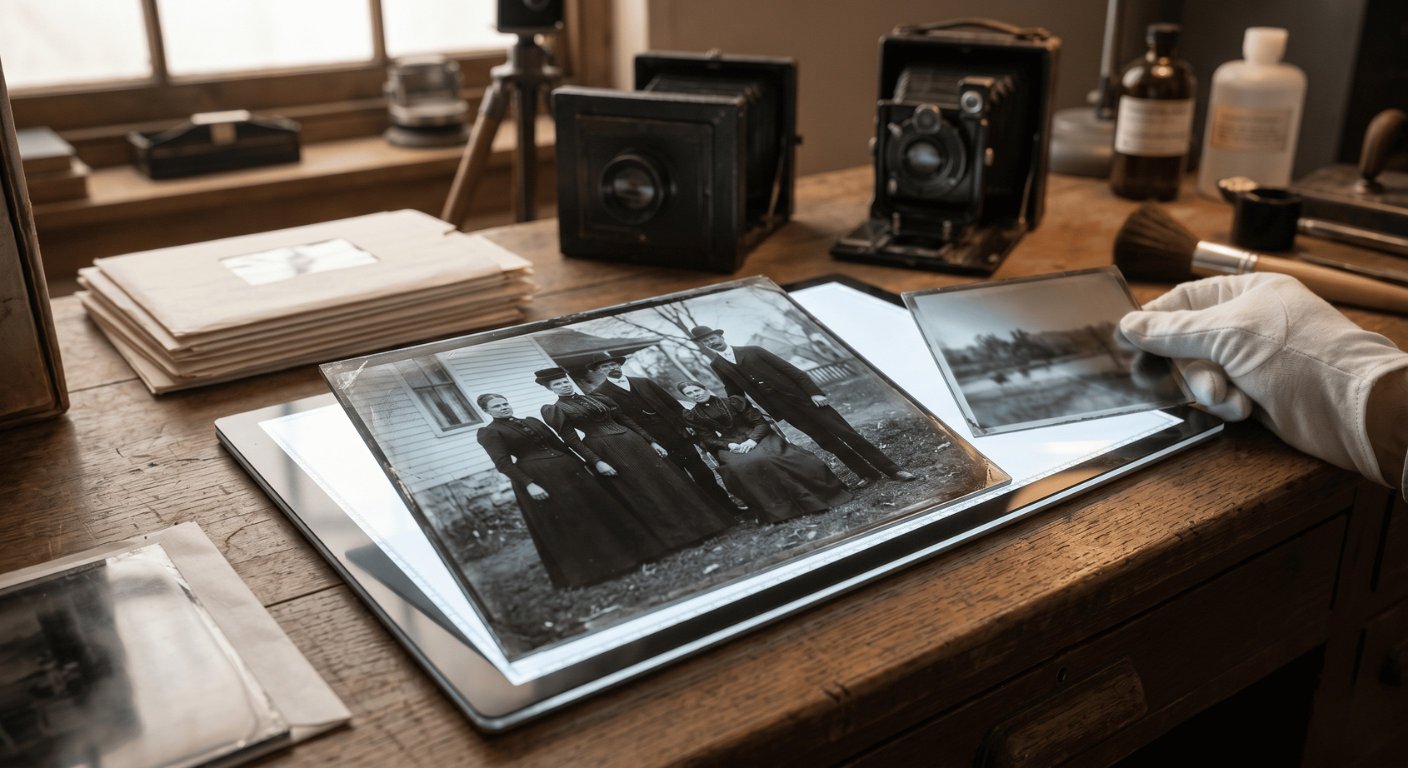
Glass plate negative scanning converts photographic images from fragile glass substrates into high-resolution digital files. These images come primarily from wet collodion and gelatin dry plates. Production of these plates occurred between 1851 and the early 1900s. The process supports long-term preservation and access.
Glass plate photography was not designed to be fragile. Its adoption across the second half of the nineteenth century stemmed from the stability and dimensional accuracy that glass offered. This outperformed every competing medium. Yet, the photographic collections recorded on it are deteriorating. The pace outstrips the resources most institutions, estates, and private collectors can direct toward preservation.
Did you know that the Harvard College Observatory photographed the night sky on glass plates from the 1880s through 1992, accumulating over 500,000 plates? Its DASCH (Digital Access to a Sky Century at Harvard) digitization program took two decades to complete, and converted 435,763 plates into digital equivalents, finishing its final scan on March 28, 2024. (Source)
If it required twenty years and the resources of one of the world’s leading research universities to digitize a single institutional collection, the arithmetic for the millions of glass plate negatives held in smaller institutions, private estates, and uncatalogued collections worldwide is sobering. Most of those plates have no digitization program. They lack conservation budgets and timelines. They are deteriorating now, in whatever environment they currently occupy. erecordsusa.com offers accessible scanning solutions to help preserve these at-risk negatives.
What are Glass Plate Negatives? A Primer on 19th Century Photographic Technology
Glass plate negatives are 19th-century photos on glass sheets coated with light-sensitive emulsions like collodion, gelatin, or albumen. They capture images in reverse (negative) tones for printing positives. Fragile and fading, they need expert digitization.
Understand the three main formats next. Each has unique looks, handling, and risks. Collections often mix them up, unlabeled.
1. Formats at a Glance
| Format | Period | Appearance | Key Risks |
|---|---|---|---|
| Wet Collodion | 1851–1890s | Milky brown/amber; varnished | Edge cracking, brittleness |
| Gelatin Dry Plate | 1880s–1920s+ | Clear neutral tones; matte | Delamination, silver mirroring, mold |
| Albumen on Glass | 1850s | Warm amber/yellowish; textured | Emulsion fragility, texture loss |
2. Wet Collodion: First Practical Process
Frederick Scott Archer launched it in 1851. Coat glass with collodion. Sensitize with silver nitrate. Expose wet. Develop in 15 minutes. Portable darkrooms required. Mathew Brady: Civil War. Timothy O’Sullivan: West surveys. Roger Fenton: Crimea. Ruled 1850s–1880s.
3. Gelatin Dry Plate: Scalable Shift
Richard Leach Maddox, 1871. Store and process dry plates later. Factory-coated. Ended the wet era by the 1880s. Signs: Clear tones, matte surface, blue sheen (mirroring), machine edges.
4. Albumen on Glass: Hidden Format
1850s overlooked type. Egg white, salts, silver. Warm amber, textured. Spot for safe scanning.
Despite flexible film becoming commercially available in the 1880s, glass plates remained the preferred medium for scientific and astronomical photography well into the twentieth century for one reason: dimensional stability.
Glass stays rock-steady. Film warps. Key differences:
- Humidity: Glass ignores it – no expansion or contraction. Film shifts measurably.
- Temperature: Glass holds firm. Film distorts.
- Precision: Glass excels in astronomy, microscopy, and cartography. The film falls short of exact measures.
- Post-1903: Glass for science and archives. Film for everyday snaps.
Now, let’s explore the reasons of glass plate negatives deterioration in the nest section.
How Glass Plate Negatives Deteriorate & Why Time Is a Factor?
The deterioration of glass plate negatives is not a slow, uniform process. It is a cascade of interacting mechanisms:
- Some driven by the chemistry of the emulsion,
- Some by the glass substrate itself, and
- Some by the storage environment that can accelerate dramatically under the wrong conditions.
Gelatin Plate Delamination – The Role of Humidity Fluctuation
The gelatin binder is hygroscopic, it absorbs moisture and swells, then contracts as humidity drops. Repeated cycles weaken adhesion between the emulsion layer and the glass surface. When RH rises above 70% at temperatures above 22°C, conditions become favorable for fungal growth that physically consumes the gelatin.
⚠️ Warning sign: Delamination often produces no visible warning until the emulsion begins to lift, blister, or peel. At that point, standard scanning becomes impossible without specialist conservation intervention. (Source)
Silver Mirroring – What It Looks Like and What It Signals
Silver mirroring appears as a blue-metallic, mirror-like sheen, most visible at oblique angles, concentrated in shadow areas and edges where silver density is highest.
How it forms:
- Silver ions migrate from within the emulsion to the image surface
- They are reduced to metallic silver in a very thin reflective layer
- Driven by: oxidative atmospheric gases + sulfurous or peroxide-containing enclosure materials + elevated humidity
Scanning implication: Mirrored areas can be captured digitally — but the scanning setup must account for specular reflection. Standard flatbed scanning under diffuse illumination frequently causes mirrored areas to read as blank or washed out.
Collodion Edge Cracking and Irreversible Image Loss
Wet collodion plates are subject to network cracking, concentrated at edges and corners where the collodion layer is thinnest. Once cracks propagate across the image field, the photographic information in those areas is permanently lost.
Causes of collodion cracking:
- Natural brittleness of aged collodion
- Physical stress from inadequate housing
- Internal tension from original drying and varnishing
Scanning protocol: Stable cracks can often be scanned safely. Actively flaking collodion plates require conservation stabilization (humidification and consolidation) before any scanning or handling is attempted.
Mold on Gelatin Binders — Identification and Isolation
Mold presents as irregular, circular, or radial staining, haze, or discrete colonies visible under raking light. Unlike silver mirroring (a chemical process), mold is biological — it physically consumes the gelatin. Active mold spreads from plate to plate, requiring rapid isolation upon discovery.
Chemically Unstable 19th Century Glass — The Underreported Threat
This deterioration factor appears in no standard handling guide, and it is missed in virtually every competing resource on glass plate care.
Nineteenth-century glass manufacturing was not standardized. Some glass produced during this period, particularly used for certain collodion plates is chemically unstable. As it deteriorates, it produces decomposition products that deposit on the plate surface.
| RH Condition | What Happens to Unstable Glass |
|---|---|
| Below ~40% RH | Decomposition products form crystalline deposits on the non-image surface |
| Above ~40% RH | Deposits dissolve into the solution and migrate into the image layer, causing silver deterioration and promoting binder/varnish flaking |
This is not emulsion deterioration caused by the glass — it is deterioration of the glass itself, expressing outward through the image.
Identifying Your Glass Plate Collection Before Scanning
Audit first to scope projects and spot conservation needs.
1. Visual ID by Format
- Wet Collodion (1851–1890s): Milky brown/amber in light; varnished sheen; rough edges.
- Gelatin Dry (1880s–1920s+): Clear neutral tones; matte; machine edges; faint blue sheen.
- Albumen (1850s): Warm amber throughout; smoother translucent; machine edges.
- All typically 2–4mm thick.
2. Common Sizes & Uses
- Quarter (3.25×4.25 in): Amateur; all eras.
- Half (4.25×5.5 in): Studio/field; all eras.
- Whole (6.5×8.5 in): Portraits; 1850s–1900s.
- 5×7 / 8×10 in: Landscapes/docs; all eras.
- Mammoth (18×22+ in): Landscapes; 1860s–1880s.
⚠️ 8×10+ inches: Use two hands—high fracture risk.
3. Condition Triage
- Scan‑ready: Stable emulsion, no flaking or active mold, edge cracks only – suitable for standard scanning.
- Scan‑with‑care: Evidence of silver mirroring, minor cracks, or deposits – adjust lighting, document condition, and consider conservation consultation.
- Conserve first: Flaking emulsion, propagating cracks, active mold, or obvious chemically unstable glass – require professional conservation before scanning.
Bulk audits enable realistic time and cost estimates for estates or large institutional projects.
Glass Plate Negative Scanning: Techniques, Equipment, and FADGI Standards
Pro glass plate negative scanning matches equipment to collection type. It follows handling protocols for fragile formats like wet collodion or gelatin dry plates. Decades of experience shape glass plate digitization practices. Know them to evaluate professional scanning services and documentation.
1. Flatbed vs DSLR Glass Plate Scanner Comparison
| Factor | Flatbed Glass Plate Scanner | DSLR/Mirrorless + Lightbox |
|---|---|---|
| Throughput | High—automated high-volume scanning | Lower—manual per glass negative |
| Max Size | Up to 8×10 in | Unlimited (mammoth plate scanning) |
| Light Control | Fixed diffuse | Adjustable for damaged negatives |
| Best For | Stable archival glass plates | Oversized/mirrored glass negatives |
| Newton’s Rings | Risk—needs mitigation | Eliminated |
| Calibration | Low | High—precise TIFF master files |
💡 Hybrid best practice: Flatbed for standard glass plate negatives. DSLR for oversized or damaged. Optimizes digitization throughput and quality.
2. Newton’s Rings in Glass Plate Scanning: Causes and Prevention
Iridescent patterns from glass-platen contact. Ruins negative detail. Unfixable in post.
Pro glass plate scanning fixes:
- Anti-Newton textured platens.
- Elevated holders.
- Camera capture—no contact.
3. Emulsion-Side Placement for Glass Negatives
Place emulsion down on flatbed or facing lens in copy stand for sharp glass plate scans.
| Placement | Effect on Glass Negative Digitization |
|---|---|
| Emulsion down (correct) |
Direct light—max sharpness, low risk |
| Emulsion up (wrong) |
Softens detail; damages flaking emulsion |
Spot emulsion side: Matte under raking light, textured, tacky on gelatin plates.
4. Cold Light Sources for Safe Glass Plate Scanning
Tungsten heat softens emulsions, causes delamination in glass negatives.
Standard: Cold LEDs, fluorescents, diffused daylight. No IR. For deteriorated plates: Fast shutters, single-pass flatbed scanning.
5. FADGI Standards for Glass Plate Negative Digitization
Library of Congress FADGI guidelines for archival scanning.
| Scan Purpose | Min PPI | Recommended PPI |
|---|---|---|
| Access files | 400 | 600 |
| Archival masters | 600 | 1200+ |
| Mammoth/scientific plates | 1200 | 2400–4000 |
Why Preservation Standards Exist: File Formats, Resolution, and Metadata in Historical Context?
The technical specifications that govern archival glass plate digitization were not invented arbitrarily. They emerged from decades of institutional experience with format obsolescence, data loss, and the practical requirements of long-term digital stewardship.
1. Output Format Comparison
| Format | Compression | Data Loss | Best Use | Institutional Standard |
|---|---|---|---|---|
| Uncompressed TIFF | None | None | Archival master file | ✅ Primary — LOC, NARA, FADGI |
| LZW-compressed TIFF | Lossless | None | Master file (space-saving compromise) | ✅ Accepted |
| JPEG2000 (lossless) | Lossless | None | Large institutional archives, DAM ingestion | ✅ Accepted (not universal) |
| JPEG | Lossy | Permanent on every save | Access copies, web delivery only | ❌ Not for masters |
| PNG | Lossless | None | Web access copies | ❌ Not standard for archival |
Why uncompressed TIFF? The Library of Congress’s Recommended Formats Statement identifies uncompressed TIFF as the preferred format for still image preservation – open, non-proprietary, lossless, and independent of any decompression algorithm that could become unavailable in future software environments.
2. 8-Bit vs. 16-Bit — What Tonal Information Is at Stake
| Specification | 8-Bit | 16-Bit |
|---|---|---|
| Tonal values per channel | 256 | 65,536 |
| Used in | Consumer photography | Archival scanning |
| Shadow/highlight detail | Discarded in extreme ranges | Fully captured |
| Post-processing flexibility | Limited — lost data cannot be recovered | Maximum — full range available for derivative production |
| File size (approx. 4×5 plate at 4000 PPI) | ~300–400 MB | 600–800 MB |
A 16-bit master file is scanned once for permanence. Access derivatives – 8-bit JPEGs, web-optimized copies can be regenerated from it indefinitely. An 8-bit master cannot be upgraded after the fact.
3. Metadata Schemas – Choosing the Right Standard
Digitization without metadata produces image files that cannot be searched, sorted, or retrieved. For collections numbering in the hundreds or thousands, metadata is what transforms a set of files into a functional archive.
| Schema | Best For | Field Depth | Interoperability |
|---|---|---|---|
| Dublin Core | Cross-institutional sharing, aggregator ingestion (Digital Public Library of America) | 15 core elements | Highest — universal |
| IPTC | Rights management, photographer attribution, keyword-rich cataloging | Rich — location, copyright, caption, keywords | High — embedded in TIFF/JPEG |
| Custom institutional | Museum databases, archival management software, library cataloging platforms | Unlimited — project-specific fields | Internal — mapped to existing system |
💡 For institutional clients with existing collection management systems, the metadata schema must be mapped to your data architecture at the project design stage, not retrofitted after scanning is complete.
Planning a Bulk Glass Plate Scanning Project – Scope, Timelines, and Logistics
For estates, institutional archivists, and private collectors managing significant glass plate holdings, a bulk digitization project involves decisions that shape cost, timeline, and quality long before any plates are scanned.
Scope Document Checklist
Before engaging a digitization service, a scope document should specify:
Questions to Ask a Digitization Provider Before Committing
- Is all scanning performed in-house, or is any work subcontracted?
- What temperature and humidity standards are maintained in the scanning environment?
- How are plates identified during intake as requiring conservation attention handled?
- What is the QC review process, and who reviews completed scans?
- What metadata schema options do you support, and can custom fields be accommodated?
- What secure transport and insurance protocols are used during transit?
- What chain-of-custody documentation is provided at project close?
Conclusion: Preserve Your Glass Plate Negatives Before It’s Too Late
Glass plate negatives are among the most fragile and historically significant photographic records ever made. Whether you manage an inherited estate, an institutional archive, or a private family collection, the time to act is now before delamination, silver mirroring, cracking, or mold permanently erase the images.
erecordsusa.com specializes in glass plate negative scanning with conservation‑aware workflows, ISO‑aligned practices, and preservation‑grade TIFF masters tailored to archival and scientific needs. We combine flatbed and camera‑based capture, rigorous metadata, and chain‑of‑custody documentation to ensure your collection is digitized once correctly and preserved for generations.
👉 Start your project today: Call us at 1.510.900.8800, or write us at he***@*********sa.com to get a free bulk estimate and a no‑obligation consultation.
Let’s secure your glass plate negatives before deterioration makes the decision for you.
FAQs About Glass Plate Negatives Scanning
Q1: How much does glass plate negative scanning cost?
A: Glass plate negative scanning costs vary by plate size, condition, resolution, and volume. Professional services typically charge per plate. Bulk collections and estates qualify for discounted rates. Factors include conservation triage, metadata, and file delivery format.
Q2: Can glass plate negatives be scanned at home without professional equipment?
A: Glass plate negatives can be scanned at home using a flatbed scanner with a transparency unit. However, home setups lack cold light sources, anti-Newton’s ring platens, and emulsion-safe handling. Deteriorated or mold-affected plates require professional conservation-grade equipment.
Q3: What is the difference between a glass plate negative and an ambrotype?
A: A glass plate negative produces a transparent image used for printing positives. An ambrotype uses the same wet collodion process but is intentionally underexposed and backed with dark material to appear as a positive. Ambrotypes are direct positives; glass plate negatives are not.
Q4: How do I print or reproduce images from scanned glass plate negatives?
A: Scanned glass plate negatives are delivered as digital TIFF files, which are inverted to positive images during processing. These files can be printed via any professional photo lab, published digitally, or ingested into a digital asset management system for institutional access.