
How do you choose a reliable book scanning provider when your multimodal AI project requires more than searchable PDFs?
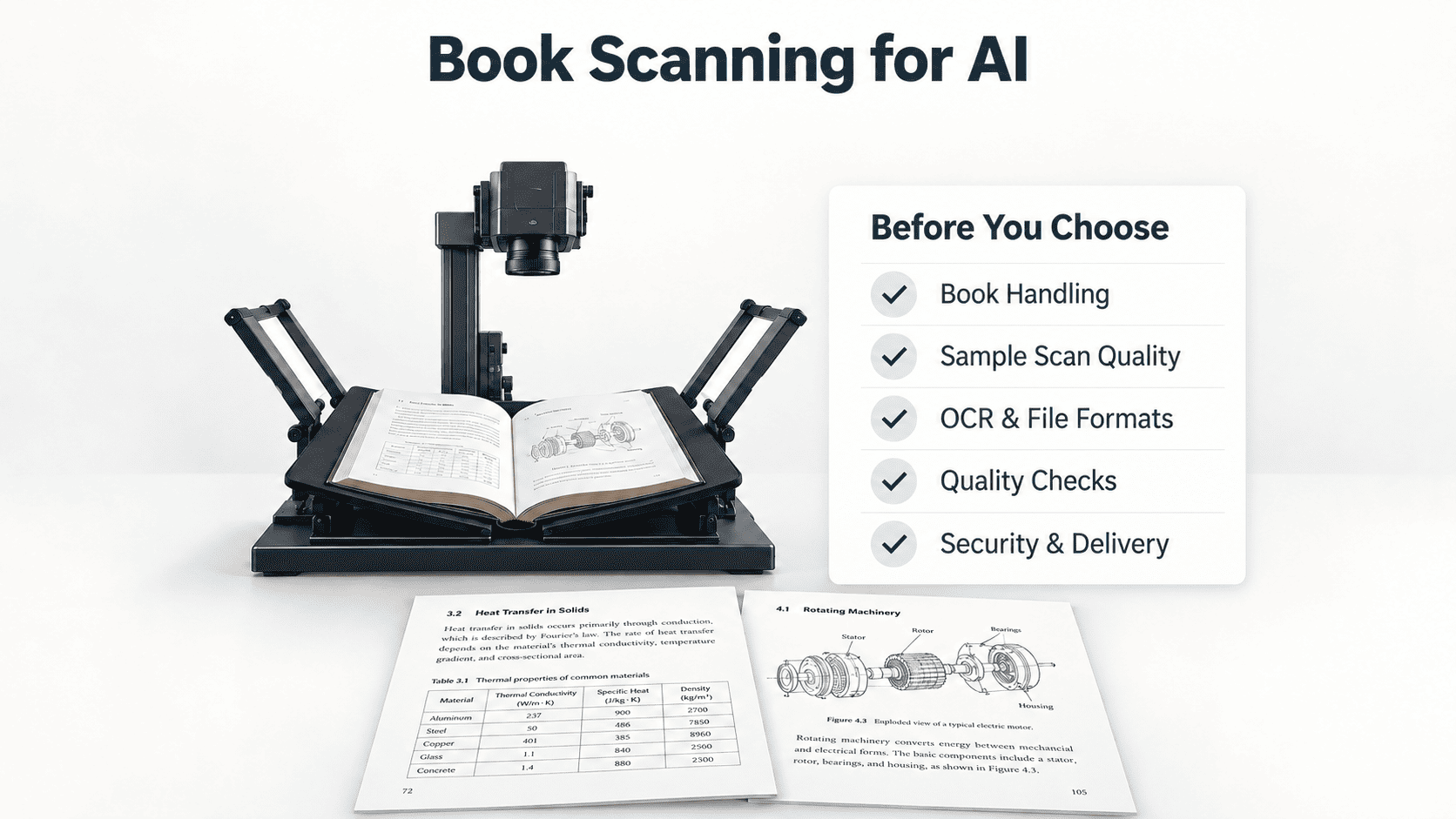
AI companies should evaluate whether a book scanning provider for AI companies can accurately capture text, tables, diagrams, illustrations, and captions while preserving image quality and source-page traceability.
AI companies preparing large book collections often need answers to important questions:
- What scanning resolution and file formats are suitable?
- How accurate will the OCR output be?
- Can the provider handle fragile or tightly bound books without losing information?
- How can buyers verify scanning quality before approving thousands of pages for digitization?
These questions matter because a visually readable scan may still lack the metadata or structured outputs needed for downstream multimodal AI processing.
Before committing to a book scanning provider, buyers should confirm that its scanning capabilities, sample deliverables, quality controls, and project terms match their technical requirements.
Quick Answer: What Should AI Companies Ask a Book Scanning Provider?
AI companies should evaluate a book scanning provider based on five essential requirements:
- Collection handling: Can the provider safely process different bindings, fragile books, oversized pages, and large-volume collections?
- Sample scan quality: Can it demonstrate clear capture of text, tables, diagrams, illustrations, and captions using representative book pages?
- Digital deliverables: Will it provide the required page images, OCR text, file formats, metadata, and any separately agreed structured outputs?
- Quality assurance: How will image defects, missing pages, OCR accuracy, and rejected files be checked and corrected?
- Project requirements: Can the provider meet agreed production timelines, security controls, chain-of-custody procedures, and delivery terms?
The best way to evaluate a scanning provider is to review representative sample files against documented acceptance criteria before authorizing bulk production.
1. Can the Provider Handle Your Book Collection?
A qualified book scanning provider should assess the physical collection before recommending a digitization approach. This helps determine whether the books can be processed safely and whether the proposed method is suitable for the project.
Start by sharing the approximate number of volumes, binding types, page dimensions, physical condition, and any unusual materials.
Technical books may contain foldout diagrams, glossy illustrations, handwritten annotations, or oversized tables. These features can require different handling and capture arrangements than standard printed pages.
Ask the provider whether the collection requires destructive or non-destructive scanning.
Destructive scanning may be suitable only when the client has authorized removal of bindings and no preservation requirement applies. Non-destructive methods are generally more appropriate when original bindings must remain intact.
For additional information about production methods, see howlarge-volume destructive book scanning supports AI data projects.
The provider should also explain how it will handle exceptions, such as damaged pages or unusual book sizes, without disrupting the agreed production schedule.
A clear collection assessment allows buyers to identify physical limitations before evaluating the digital outputs.
2. What Should You Check in a Sample Book Scan?
A sample scanning project allows AI companies to verify actual digital outputs before approving large-volume book digitization.
Rather than requesting samples from only clean, text-heavy books, select pages that represent the most technically demanding material in your collection.
Are Text, Tables, Diagrams & Captions Captured Clearly?
A representative sample should demonstrate whether the provider can capture different types of book content without losing important visual information.
Review pages containing small text, illustrations, charts, tables, multicolumn layouts, and captions.
Pay particular attention to information near the binding, where curved pages or shadows can affect visibility.
TheFederal Agencies Digital Guidelines Initiative (FADGI) distinguishes content categories and subcategories for textual and illustrated materials, including clean, high-contrast book pages as well as pages with handwritten annotations, low contrast, halftone illustrations, or included photographs.
This distinction reinforces the need to test scanning requirements against the collection’s actual characteristics.
A technically useful sample should allow the buyer to determine whether important information remains legible and whether page boundaries, visual details, and reading order are sufficiently preserved.
Can the Sample Files Be Tested in Your AI Workflow?
A visually accurate scan doesn’t automatically guarantee that its digital output will work with the buyer’s intended processing system.
Ask the provider for representative files in the proposed delivery formats.
Your technical team can then test whether the files can be opened, processed, and associated with their source pages.
For example, a document-processing system may successfully read text from a page while having difficulty interpreting the relationship between a diagram and its caption.
Testing should identify such limitations before production.
The scanning provider is responsible for meeting agreed digitization specifications, while the AI company should verify whether those deliverables are suitable for its downstream processing requirements.
3. Which Digital Outputs Should the Provider Deliver?
Before signing an agreement, AI companies should define exactly which digital files, text outputs, and metadata they expect to receive.
The required deliverables depend on how the digitized books will be processed, stored, or integrated into existing systems.
Will You Receive Page Images, OCR Text & Metadata?
Ask whether the provider will supply original page images, searchable documents, separately accessible OCR text, or a combination of these outputs.
Common scanning deliverables include file formats such as TIFF or JPEG page images and OCR-enabled PDF files. Additional text exports and metadata should be explicitly included in the project scope when required.
File naming and page identification are equally important.
Each digital page should be traceable to its source volume, with a consistent method for identifying books, page sequences, and associated files.
Without that structure, individual page images and text files can become disconnected from the organization of the original book.
For AI companies processing large collections, consistent identifiers and agreed metadata fields make it easier to organize files and maintain source references.
Are Tables, Diagrams & Other Visual Elements Available as Structured Data?
There is an important difference between capturing a table as an image and delivering its contents as structured data.
A scanned page may preserve the complete table appearance without providing separate data fields for rows, columns, or individual cells.
Similarly, a diagram may be visible in a digital image without having machine-readable labels or relationships between its components.
Before approving the project, ask whether the deliverables include only scanned images and OCR text or additional structured extraction.
If your AI workflow requires table data, figure descriptions, caption associations, layout coordinates, or other annotations, these requirements must be defined separately.
Do not assume that a searchable PDF includes complete multimodal data extraction.
Clear deliverable specifications help buyers avoid paying for files that don’t meet their intended technical requirements.
4. How Will the Provider Verify Scanning Quality?
Scanning quality should be evaluated against documented acceptance criteria rather than general promises of high accuracy.
Ask the provider how image quality, file completeness, OCR output, and delivery consistency will be inspected throughout production.
The FADGI Technical Guidelines for Digitizing Cultural Heritage Materials, Third Edition (2023) provide a recognized framework for evaluating digital image quality. (Source)
These guidelines address imaging characteristics and performance measurement for materials including textual documents, photographs, and other still-image content.
Buyers should ask which quality requirements are appropriate to their collection and how the provider will verify them.
There is no single scanning resolution or quality threshold that suits every book or AI use case.
Before production begins, agree on how the provider will identify and correct:
- Missing, duplicated, or incorrectly sequenced pages.
- Cropped content, blur, glare, or other image defects.
- OCR errors exceeding agreed acceptance limits.
- Files that fail the required format or metadata checks.
The agreement should also specify when rejected files will be rescanned, how corrected files will be delivered, and who approves the completed batch.
5. What Should You Confirm Before Approving a Bulk Scanning Project?
Once sample files and quality requirements have been reviewed, the final decision should focus on whether the provider can deliver the full collection under clearly defined project terms.
First, confirm production capacity and scheduling.
Ask how many volumes the provider can process within the required timeframe and whether the schedule accounts for preparation, exceptional materials, quality review, and final delivery.
A scanning capacity estimate should reflect the characteristics of your collection rather than a theoretical maximum pages-per-hour figure.
Next, verify collection security and accountability.
The provider should explain
- How books are recorded during intake,
- How their movement is tracked,
- Who can access them, and
- How digital files will be transferred.
For confidential technical publications or proprietary research materials, discuss access restrictions, NDA-backed confidentiality, and secure handling arrangements before transferring the collection.
Finally, review the complete commercial scope.
A project quote should distinguish scanning costs from additional services such as OCR, custom indexing, specialized metadata, file conversion, exception handling, or physical-material disposition.
It should also confirm whether original books will be returned, retained, or destroyed only with authorization.
Comparing these conditions helps buyers understand what each provider is actually delivering, rather than selecting a quote based solely on its per-page price.
How Can eRecordsUSA Support Your Book Digitization Requirements?
eRecordsUSA provides professionalbook scanning services for organizations managing large collections of technical publications, research materials, and bound records.
As a book scanning provider for AI projects, eRecordsUSA can help buyers assess their physical collections and define appropriate scanning requirements, including image capture, OCR-enabled files, metadata options, and delivery formats.
Our in-house scanning operations in Fremont, California, support controlled material handling, secure intake and chain-of-custody tracking, and quality review.
Organizations can discuss specialized collection requirements and request a project-specific assessment to determine which scanning methods and digital outputs are suitable for their intended applications.
Confirm Your Book Digitization Requirements Before Production
Preparing a large collection for multimodal AI processing requires agreement on the physical materials, digital deliverables, and quality expectations before scanning begins.
Contact eRecordsUSA to discuss your collection and request a customized scanning quote.
Frequently Asked Questions
Should AI companies request a sample scan before approving bulk digitization?
Yes. A sample scan helps AI companies evaluate image quality, OCR results, page completeness, and file compatibility before committing an entire collection to digitization.
Is a searchable PDF enough for multimodal AI processing?
Not always. A searchable PDF provides page images and recognized text, but it may not include structured tables, figure relationships, or the metadata required for specific multimodal AI workflows.
Can a scanning provider deliver book images without AI data annotation?
Yes. Professional scanning providers can deliver digital page images and agreed OCR outputs without performing AI annotation. Structured extraction and labeling should be specified separately when required.


